• Exhibitions
  • SHOP
  • NEW ARRIVALS
  • Artists
  • Contact
  • News
  • WE BUY ART
Menu

Maxwell Alexander Gallery

  • Exhibitions
  • SHOP
  • NEW ARRIVALS
  • Artists
  • Contact
  • News
  • WE BUY ART
Scan.jpg

Southwest Art Magazine on Grant Redden's Upcoming Solo Show

April 1, 2019

In a small solo show opening at Maxwell Alexander Gallery on Saturday, April 6, Wyoming artist Grand Redden captures timeless vignettes of the cowboy, his horse, and the land upon which he works. If the showcase conjures the spirit of early cowboy artists like Fran Tenney Johnson and W. Herbert Dunton, who captured the Old West, Redden wouldn’t mind the comparison. In the half dozen oil paintings he brings to the show, the artist seeks to share a bit of his own western heritage with viewers.

Redden’s paternal ancestors were among the first pioneers to settle in southwest Wyoming, and he himself grew up in the region on his father’s sheep and cattle ranch. Today he lives with his wife and family in the area, where he raises a small herd of sheep, chickens, and a few cows on 120 acres of pastureland. It’s a way of life that has always appealed to the artist— modernized methods of farming aside. “I really don’t have much interest in painting tractors,” he admits unapologetically. “With some of my work, I try to make it look like the cowboy and western life from 1900 to the 1930s. The Zane Grey and Gene Autry period is an exciting and interesting time to people, and I think contemporary desires are reaching back to that time.”

Over the nearly three decades he has been painting, Redden has studied with acclaimed artists ranging from Jim Norton to Gerald Fritzler to Walt Gonske. He has also closely observed the techniques of a variety of living and deceased masters. “How I paint is as important to me as what I paint,” says Redden. who was inducted into the exclusive Cowboy Artists of America in 2012. “The longer I paint, the more excited I get about the craftsmanship that goes into a well-made painting—the textures, the colors, the design. I’m more focused on using large shapes and bright colors in a harmonious way, and I use a lot of sanding and glazing.”

Also propelling Redden forward on his creative path is the ongoing urge to share his world with others. “If you haven’t ridden a bobsled with a load of hay, it’s amazing—the sounds, the smells,” says the artist. Of course, while he can’t arrange for viewers to physically experience such pleasures he adds, “I can paint it for them.” And being able to do that, says Redden, “is like being paid to eat ice cream.”

Tags Grant Redden, Southwest Art Magazine, Wyoming, Cowboy paintings, Western Art, Maxwell Alexander Gallery
Outwest-pub1-WEB.jpg Out-West-pub2-WEB.jpg

WESTERN ART COLLECTOR MAGAZINE TAKES A LOOK AT THE FORTHCOMING "OUT WEST" EXHIBITION

March 1, 2019

Three Perspectives

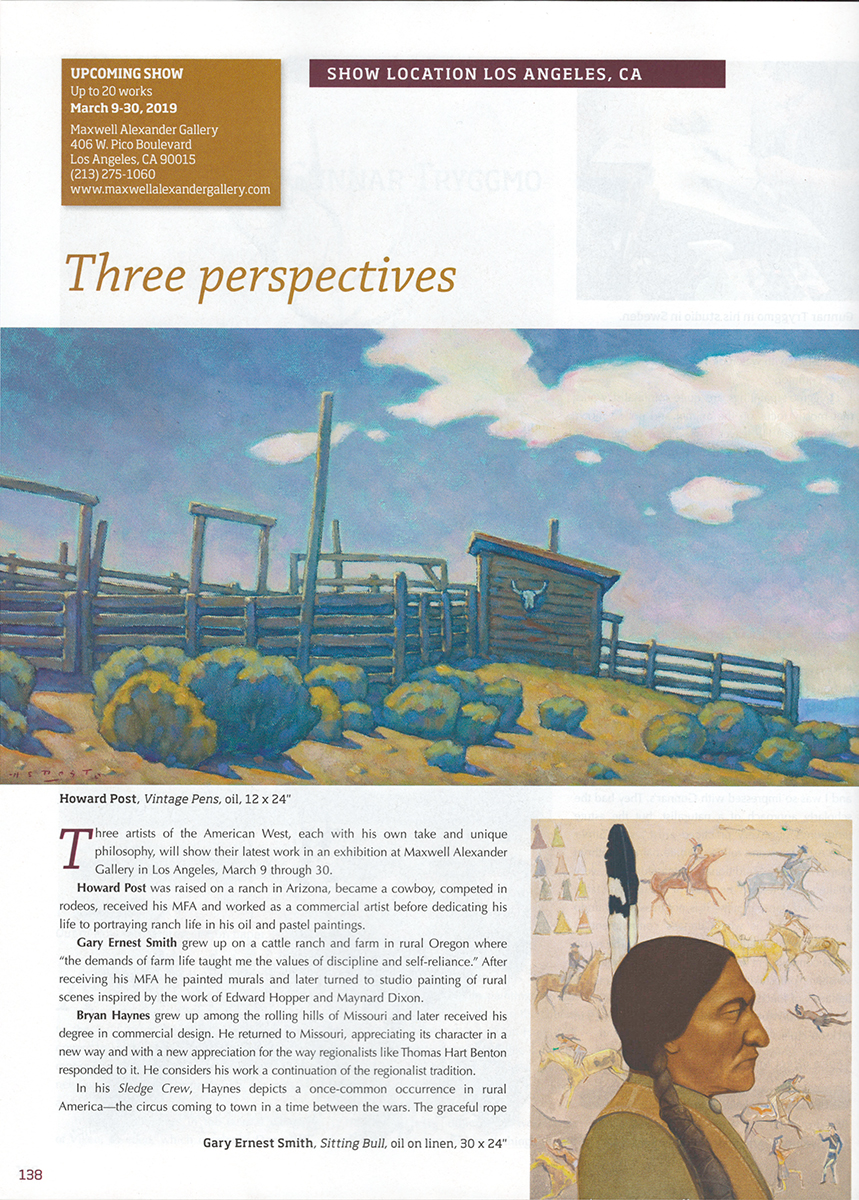
Three artists of the American West, each with his own take and unique philosophy, will show their latest work in an exhibition at Maxwell Alexander Gallery in Los Angeles, March 9 through 30.

Howard Post was raised on a ranch in Arizona, became a cowboy, competed in rodeos, received his MFA and worked as a commercial artist before dedicating his life to portraying ranch life in his oil and pastel paintings.

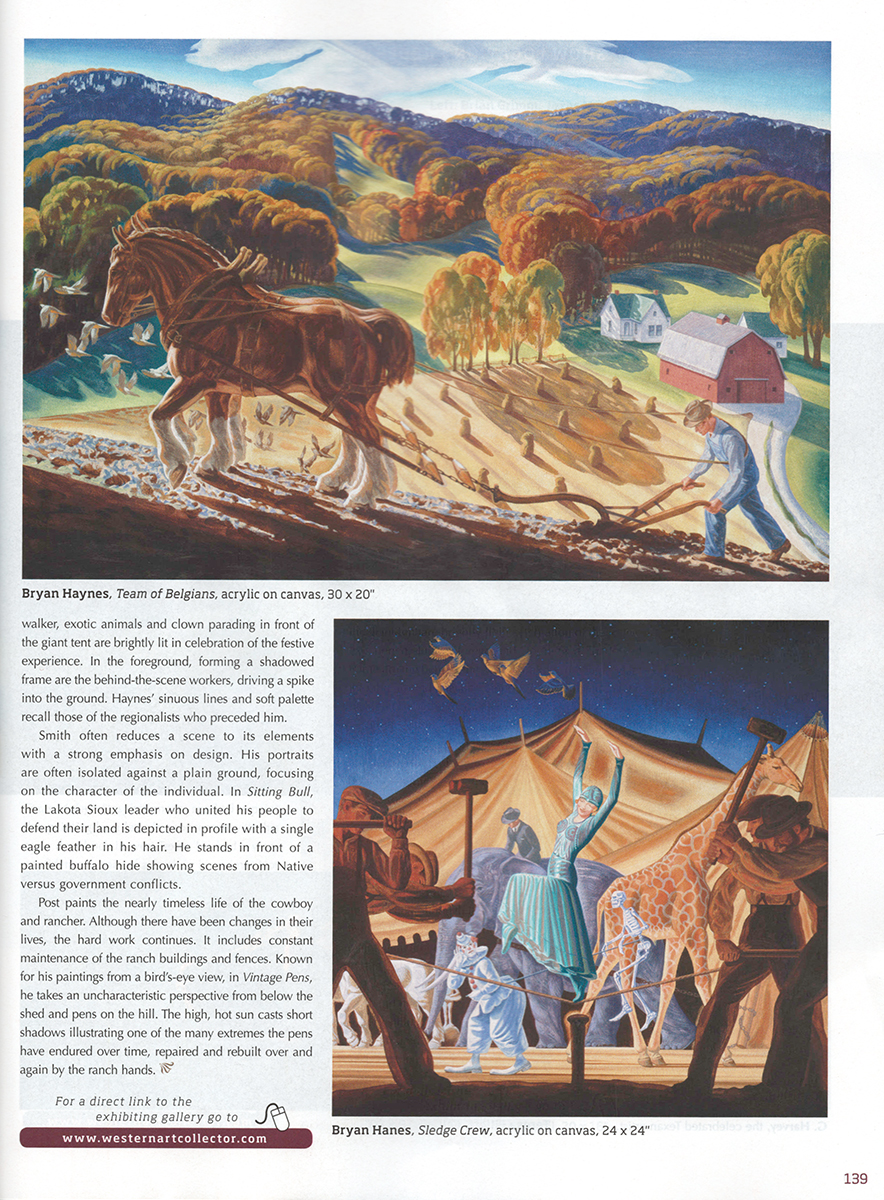
Gary Ernest Smith grew up on a cattle ranch and farm in rural Oregon where “the demands of farm life taught me the values of discipline and self-reliance.” After receiving his MFA he painted murals and later turned to studio painting of rural scenes inspired by the work of Edward Hopper and Maynard Dixon.

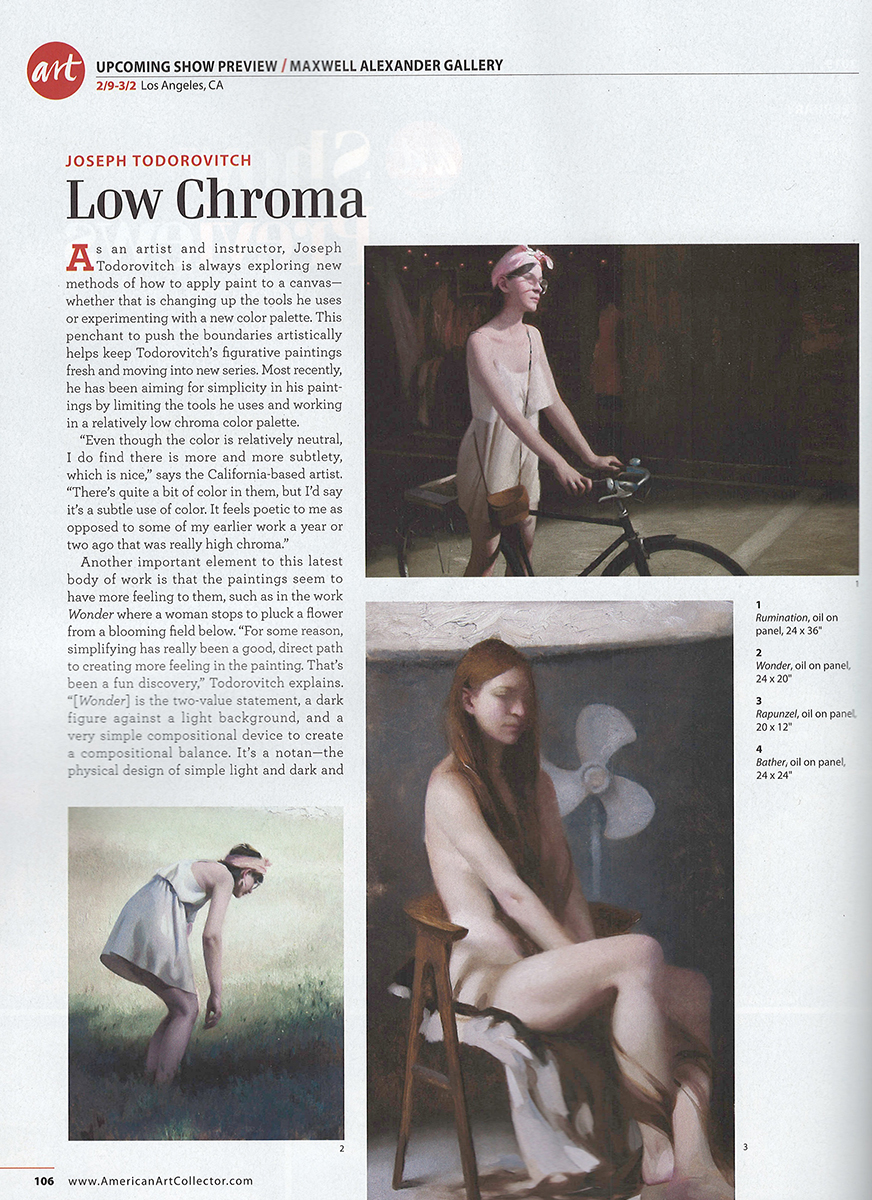
Bryan Haynes grew up among the rolling hills of Missouri and later received his degree in commercial design. He returned to Missouri, appreciating its character in a new way and with a new appreciation for the way regionalists like Thomas hart Benton responded to it. He considers his work a continuation of the regionalist tradition.

In his Sledge Crew, Haynes depicts a once-common occurrence in rural America— the circus coming to town in a time between the wars. The graceful rope walker, exotic animals and clown parading in front of the giant tent are brightly lit in celebration of the festive experience. In the foreground, forming a shadowed frame are the behind-the-scenes workers, driving a spoke into the ground. Haynes’ sinuous line and soft palette recall those of the regionalists who preceded him.

Smith often reduces a scene to its elements with a strong emphasis on design. His portraits are often isolated against a plain ground, focusing on the character of the individual. In Sitting Bull, the Lakota Sioux leader who united his people to defend their land is depicted in profile with a single eagle feather in his hair. He stands in front of a painted buffalo hide showing scenes from Native versus government conflicts.

Post paints the nearly timeless life of the cowboy and rancher. Although there have been changes in their lives, the hard work continues. It includes constant maintenance of the ranch buildings and fences. Known for his paintings from a bird’s-eye view, in Vintage Pens, he takes an uncharacteristic perspective from below the shed and pens on the hill. The high, hot sun casts short shadows illustrating one of the many extremes the pens have endured over time, repaired and rebuilt over and again by the ranch hands.

Tags Western Art Collector Magazine, American West, Howard Post, Bryan Haynes, Gary Ernest-Smith, Western Art

Desert Survey Book by Logan Maxwell Hagege

February 24, 2019

Desert Survey, the new book, showcasing over 150 pages of Logan Maxwell Hagege’s most iconic works. Releasing February 24, 2019 at 10am PT. The first printing of Desert Survey is limited to 500 signed and numbered books.

Available to purchase exclusively at MaxwellAlexanderGallery.com/shop/

Logan Hagege  Feb 07 2019 3.jpg
Screen-Shot-2019-02-15-at-4.52.02-PM.jpg

Western Art Collector Magazine Highlights Maxwell Alexander Gallery

February 15, 2019

Maxwell Alexander Gallery is located in the South Park district of downtown Los Angeles, just a couple streets over from the Convention Center and Staples Center. In recent years, downtown LA has become one of the most sought after locations in Los Angeles. Maxwell Alexander Gallery is continuing its service to out-of-state clientele but has also gained a group of new collectors this past year who are new residents of downtown LA. As a result, sales have doubled in 2018 and the gallery looks forward to continue the trend in 2019. Keeping things interesting with multiple exhibitions running each month in its front and south galleries, the gallery’s primary focus is on high-quality art. “I can say with confidence, no other gallery in the Southwestern market has a roster as strong as ours. We are developing new artists’ careers, but we are lucky to have the biggest names all under on roof,” says Beau Alexander, president. In March, Maxwell Alexander Gallery is hosting a three-person exhibition featuring legendary painters Howard Post, Gary Ernest-Smith and Bryan Haynes. In April, an exhibition will be held for Grant Redden, his Los Angeles debut. In May the gallery hosts the thirst consecutive solo exhibition for Eric Bowman.

Tags Maxwell Alexander Gallery, Beau Alexander, DTLA, Los Angeles, California, Contemporary Western Art, Contemporary Gallery, Western Art, Western Art Collector Magazine, Howard Post, Bryan Haynes, Gary Ernest-Smith, Grant Redden, Eric Bowman
Screen-Shot-2019-02-15-at-4.46.06-PM.jpg

American Art Collector Magazine Interviews Beau Alexander about Maxwell Alexander Gallery in Downtown Los Angeles

February 15, 2019

Maxwell Alexander Gallery is a leading West Coast destination for some of the country’s best realists, dubbed “The New Breed of Fine Art.” The gallery specializes in middle and early career artists with exceptional technique and a unique vision. Noted artists include Jeremy Mann, Serge Marshennikov, Cesar Santos, Joseph Todorovitch, Kim Cogan, Michael Klein, Joshua LaRock and David Kassan.

“Maxwell Alexander Gallery is located in the South Park district of downtown Los Angeles, just a couple streets over from the Convention Center and Staples Center. In recent years, downtown LA has become one of the most sought-after locations in Los Angeles. Recent articles have shown 35 new high-rise building projects, many of them including residential units,” says Beau Alexander, president of the gallery.

“Needless to say, the market is booming. We are continuing to service our out-of-state clientele, but we’ve also gained a whole group of new clients this past year who are new residents of downtown LA. As a result, sales have doubled in 2018 and we look forward to continue the trend in 2019.

He continues, “The roster of master artists exhibited in our white walled, 16-foot high ceiling contemporary gallery, has transformed typically modern collectors to take a second look at contemporary realism— and add works to their growing collections. We are thrilled to be in the middle of this growing market and a worldwide destination for enthusiastic collectors.”

In February, the gallery will host an exhibition for Todorovitch featuring his new series of muted-toned figurative works that feature hist of color, creating a dreamlike sensation.

Tags Maxwell Alexander Gallery, Beau Alexander, Contemporary Realism, Contemporary Western Art, Contemporary Gallery, DTLA, Los Angeles, Jeremy Mann, Serge Marshennikov, Cesar Santos, Joseph Todorovitch, Michael Klein, Kim Cogan, David Kassan, American Art Collector Magazine
Todorovitch-American-Art1.jpg Todorovitch-American-Art2.jpg

American Art Collector Magazine's Upcoming Show Preview on Joseph Todorovitch

January 25, 2019

Low Chroma

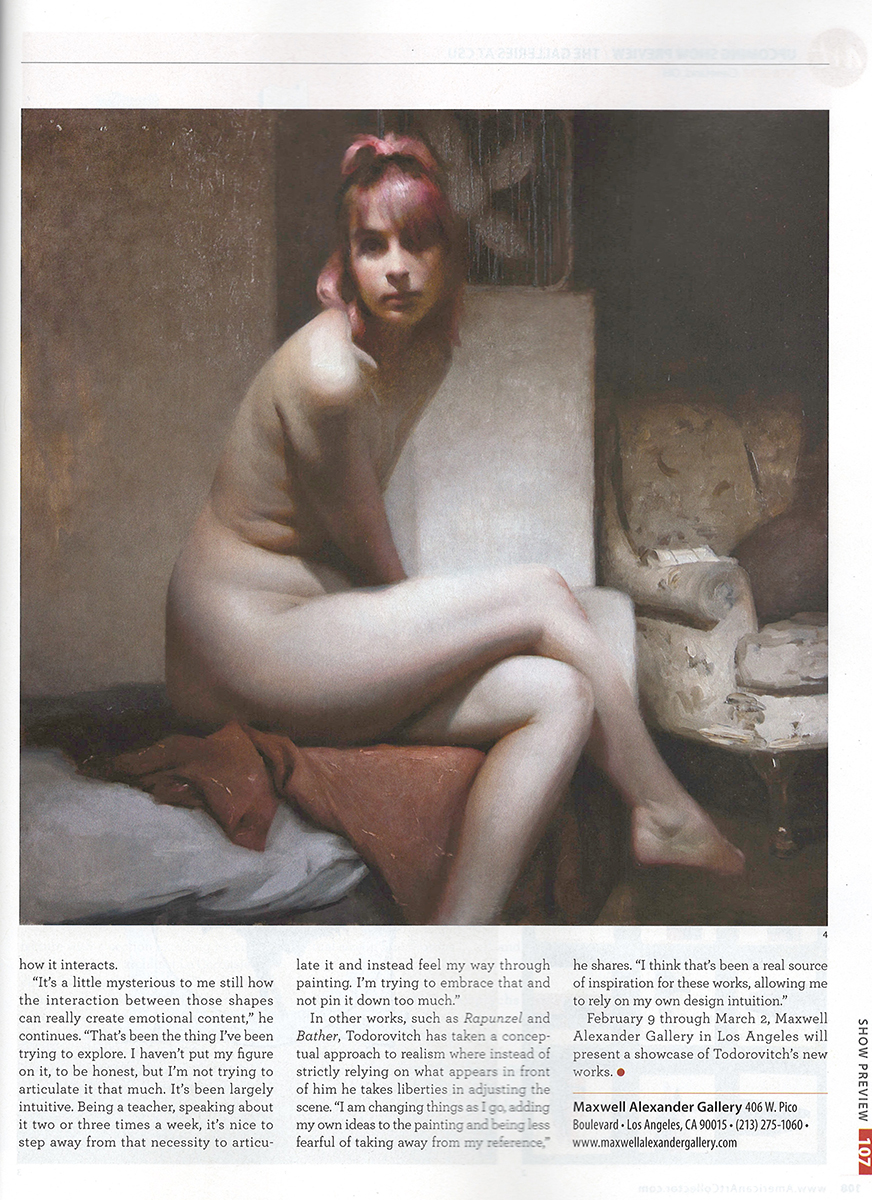
As an artist and instructor, Joseph Todorovitch is always exploring new methods of how to apply paint to a canvas— whether that is changing up the tools he uses or experimenting with a new color palette. This penchant to push the boundaries artistically helps keep Todorovitch’s figurative paintings fresh and moving into new series. Most recently, he has been aiming for simplicity in his paintings by limiting the tools he uses and working in a relatively low chroma color palette.

“Even though the color is relatively neutral, I do find there is more and more subtlety, which is nice,” says the California-based artist. “There’s quite a bit of color. It feels poetic to me as opposed to some of my earlier work a year or two ago that was really high chroma.”

Another important element to this latest body of work is that the paintings seem to have more feeling to them, such as in the work Wonder where a woman stops to pluck a flower from a blooming field below. “For some reason, simplifying has really been a good, direct path to creating more feeling in the painting. That’s been a fun discovery,” Todorovitch explains. “[Wonder] is the two-value statement, a dark figure against a light background, and a very simple compositional device to create a compositional balance. It’s a notan— the physical design of simple light and dark and how it interacts.

“It’s a little mysterious to me still how the interaction between those shapes can really create emotional content,” he continues. “That’s been the thing I’ve been trying to explore. I haven’t put my finger on it, to be honest, but I’m not trying to articulate it that much. It’s been largely intuitive. Being a teacher, speaking about it two or three times a week, it’s nice to step away from that necessity to articulate it and instead feel my way through painting. I’m trying to embrace that and not pin it down too much.”

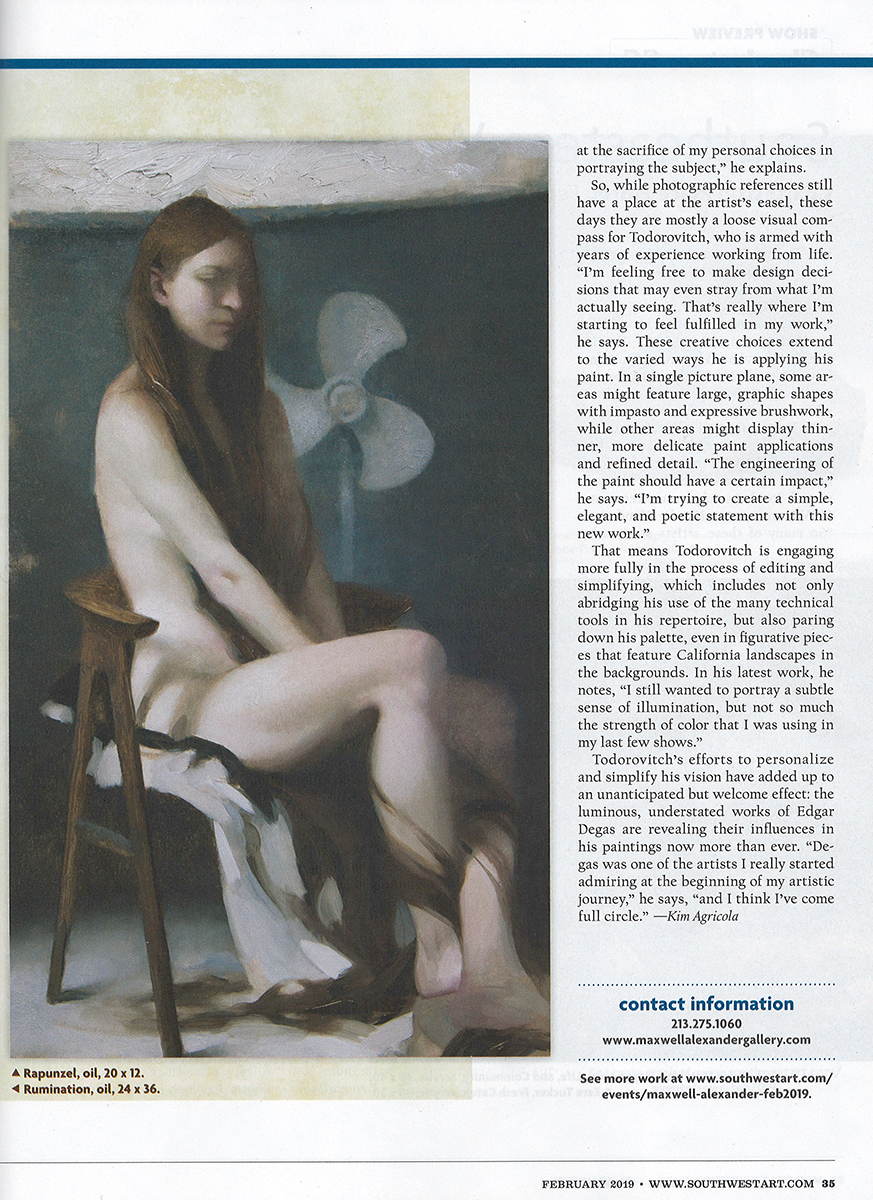
In other works, such as Rapunzel and Bather, Todorovitch has taken a conceptual approach to realism where instead of strictly relying on what appears in front of him he takes liberties in adjusting the scene. “I am changing things as I go, adding my own ideas to the painting and being less fearful of taking away from my reference,” he shares. “I think that’s been a real source of inspiration for these works, allowing me to rely on my own design intuition.”

February 9 through March 2, Maxwell Alexander Gallery in Los Angeles will present a showcase of Todorovitch’s new works.

Tags American Art Collector Magazine, Joseph Todorovitch, Figurative Painting, Solo exhibition
Todorovitch-Southwest-Art1.jpg Todorovitch-Southwest-Art2.jpg

Southwest Art Magazine Previews Joseph Todorovitch's Upcoming Solo Show

January 25, 2019

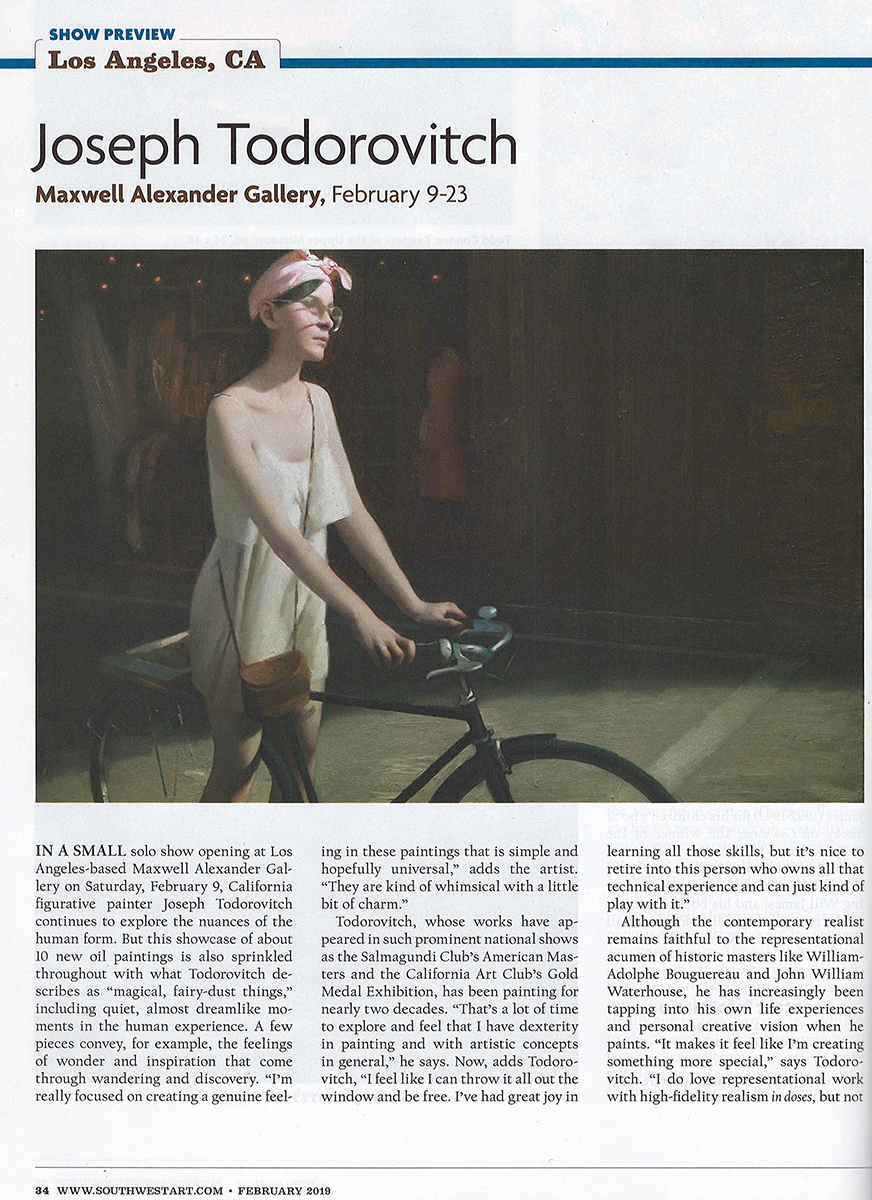
In a small solo show opening at Los Angeles-based Maxwell Alexander Gallery on Saturday, February 9, California figurative painter Joseph Todorovitch continues to explore the nuances of the human form. But this showcase of about 10 new oil paintings is also sprinkled throughout with what Todorovitch describes as “magical, fairy-dust things,” including quiet, almost dreamlike moments in the human experience. A few pieces convey, for example, the feelings of wonder and inspiration that come through wandering and discovery. “I’m really focused on creating a genuine feeling in these paintings that is simple and hopefully universal,” adds the artist. “They are kind of whimsical with a little bit of charm.”

Todorovitch, whose works have appeared in such prominent national shows as the Salmagundi Club’s American Masters and the California Art Club’s Gold Medal Exhibition, has been painting for nearly two decades. “That’s a lot of time to explore and feel that I have dexterity in painting and with artistic concepts in general,” he says. Now, adds Todorovitch, “I feel like I can throw it all out the window and be free. I’ve had great joy in learning all those skills, but it’s nice to retire into this person who owns all the technical experience and can just kind of play with it.”

Although the contemporary realism remains faithful to the representational acumen of historic masters like William-Adolphe Bouguereau and John William Waterhouse, he has increasingly been tapping into his own life experiences and personal creative vision when he paints. “It makes it feel like I’m creating something more special,” says Todorovitch. “I do love representational work with high-fidelity realism in doses, but not at the sacrifice of my personal choices in portraying the subject,” he explains.

So, while photographic references still have a place at the artist’s easel, these days they are mostly a loose visual compass for Todorovitch, who is armed with years of experience working from life. “I’m feeling free to make design decisions that may even stray from what I’m actually seeing. That’s really where I’m starting to feel fulfilled in my work,” he says. These creative choices extend to the varied ways he is applying his paint. In a single picture plane, some areas might feature large, graphic shapes with impasto and expressive brushwork, while other areas might display thinner, more delicate paint applications and refined detail. “The engineering of the paint should have a certain impact,” he says. “I’m trying to create a simple, elegant and poetic statement with this new work.”

That means Todorovitch is engaging more fully in the process of editing and simplifying, which includes not only abridging his use of the many technical tools in his repertoire, but also paring down his palette, even in figurative pieces that feature California landscapes in the backgrounds. In his latest work, he notes, “I still wanted to portray a subtle sense of illumination, but not so much the strength of color that I was using in my last few shows.”

Todorovitch’s efforts to personalize and simplify his vision have added up to an unanticipated but welcome effect: the luminous, understated works of Edgar Degas are revealing their influences in his paintings now more than ever. “Degas was one of the artists I really started admiring at the beginning of my artistic journey,” he says, “and I think I’ve come full circle.” — Kim Agricola

Tags Southwest Art Magazine, Joseph Todorovitch, Figurative Painting, Solo exhibition
IMG_0001.jpg IMG_0002.jpg IMG_0003.jpg IMG_0004.jpg IMG_0005.jpg IMG_0006.jpg

Western Art & Architecture Magazine Highlights Teresa Elliot's Work

January 10, 2019

Transcending the West: Teresa Elliott

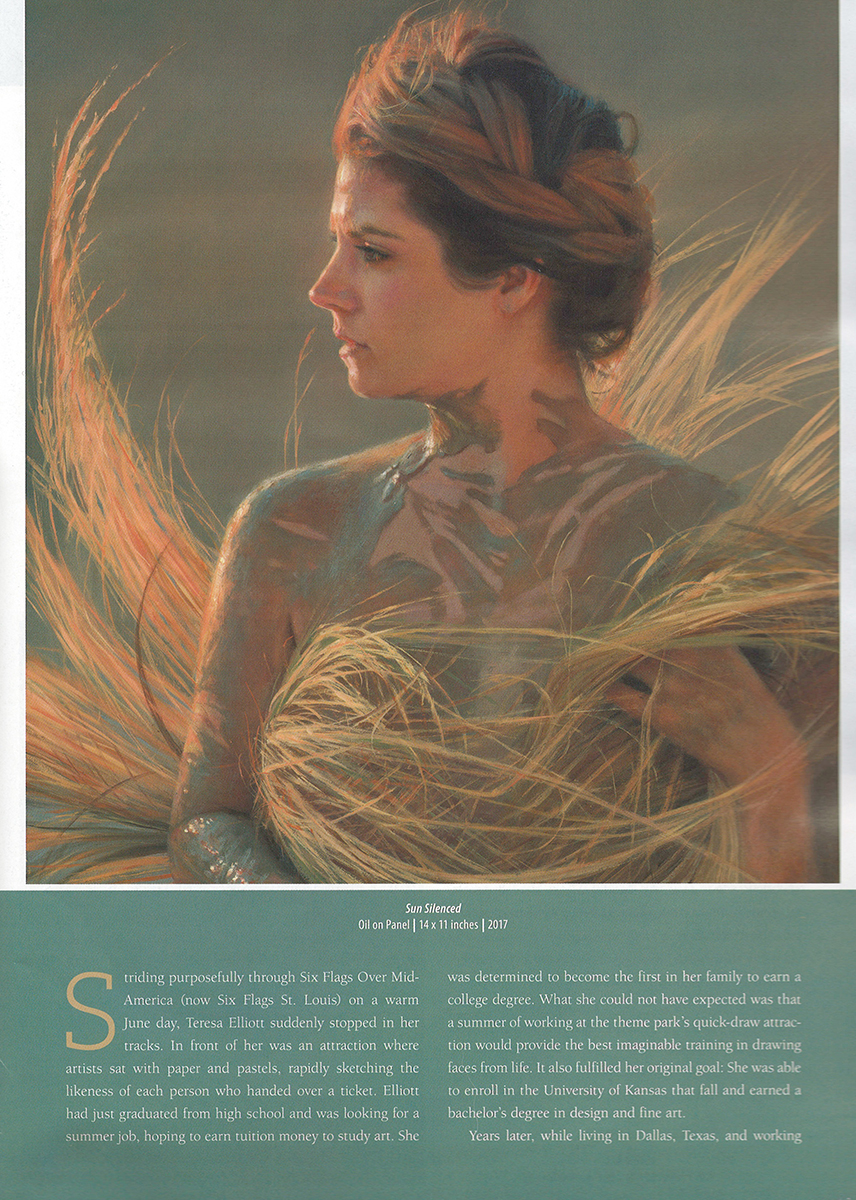
Striding purposefully through Six Flags Over Mid-America (now Six Flags St. Louis) on a warm June day. Teresa Elliott suddenly stopped in her tracks. In front of her was an attraction where artists sat with paper and pastels, rapidly sketching the likeness of each person who handed over a ticket. Elliott had just graduated from high school and was looking for a summer job, hoping to earn tuition money to study art. She was determined to become the first in her family to earn a college degree. What she could not have expected was that a summer of working at the theme park’s quick-draw attraction would provide the best imaginable training in drawing faces from life. It also fulfilled her original goal: She was able to enroll in the University of Kansas that fall and earned a bachelor’s degree in design and fine art.

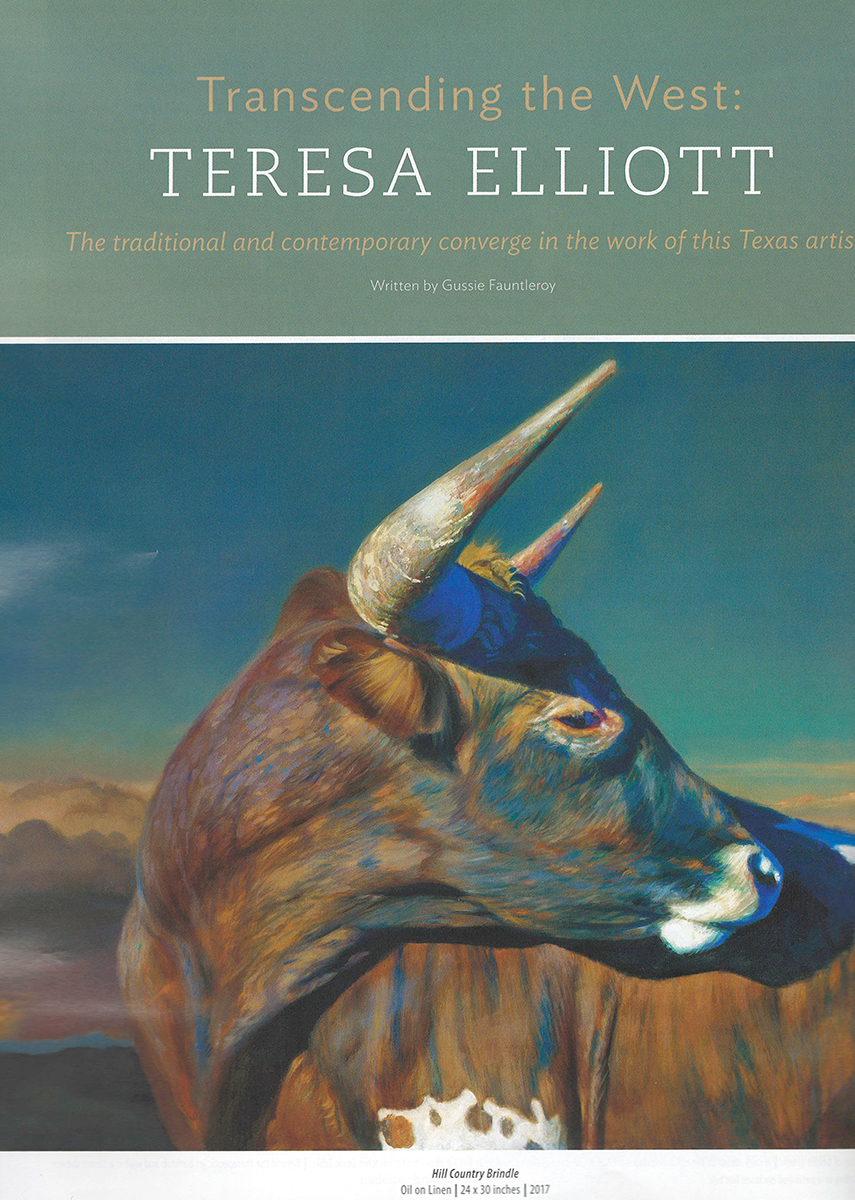
Years later, while living in Dallas, Texas and working as a freelance fashion illustrator, Elliott had another pivotal chance encounter. As she drove past a small pasture in suburban Fort Worth, she was struck by the beauty of a small group of longhorn cattle grazing there — the graceful curves of their horns, their gentle faces, the rich colors of their coats. She returned with her sketchpad and camera in the sunset’s warm glow, and later, she painted her first longhorn. Considering it simply for her own pleasure, Elliott never intended to sell it.

Fortunately, life had other plans. Within a few years, she received the first of many awards for her longhorn paintings, and her work began to gain recognition in and beyond the world of traditional Western art. Among her honors over the years: Grand Prize from the America China Oil Painting Artists League, People’s Choice at the Coor’s Western Art Exhibit & Sale, and , most recently, the Chairman’s Choice Award (for the third time) at the 2018 Art Renewal Center’s International Salon.

“Teresa is a fabulously skilled realist painter and an unmistakably Texas artist,” says Joseph M. Bravo, a Texas-based art critic, curator and former museum director. “Yet, she’s clearly contemporary in her optic. There’s something transcendent about her work that exceeds the Southwest.”

Indeed, Elliott’s art has garnered national and international acclaim and a rapidly growing collector base. In March, she takes part in the annual Night of Artists show at the Briscoe Western Art Museum in San Antonio, Texas, where her work has always sold out. And then in October, Elliott and painter Jill Soukup will share a two-artist show at Gallery 1261 in Denver, Colorado.

The world of galleries and art museums was not even on Elliott’s radar when she was growing up. As the daughter of a salesman whose work took the family to St. Louis, Kansas City, and Oklahoma City, she loved to draw but had little exposure to original art. Then, in elementary school, her parents bought a children’s encyclopedia set with a special volume on art. Sitting for hours with the big book open on her lap, she soaked up the pictures to the point that many remain imprinted in her mind today.

After her summer of intensive informal training as part of the amusement park’s quick-draw team, Elliott focused primarily on figurative art. Her skills were so remarkable that her college art professors recommended her when detectives came seeking an artist to create a police sketch of a serial rapist. Elliott met with tow of the victims and asked the women detailed questions about their attacker’s appearance, sketching their responses: How far apart were his eyes, how high was his hairline, what was his mouth like? “It’s what I do while I’m working on a painting, but I just verbalized it,” she says. Her sketch turned out to be a good likeness. The rapist was caught.

When she began painting longhorns, Elliott’s talent and instincts for portraiture found a fresh focus. She saw them as individuals, with interesting bovine eyes and distinctive demeanors, worthy of the often large=scale paintings in which they appear against backdrops of gorgeous Texas skies. Her placid longhorns reflect the relative simplicity of the bovine world. “I always like the sense of community with livestock animals. To be in a pasture with that is really comforting.” Elliott says.

As curator of the Coors Western art show, publisher, and writer Rose Fedrick puts it: “She gives her subjects a sense of royalty, grace and power, and yet there’s also something wry about her paintings, as if she’s looking back and giving a wink to old Leonardo di Vinci.”

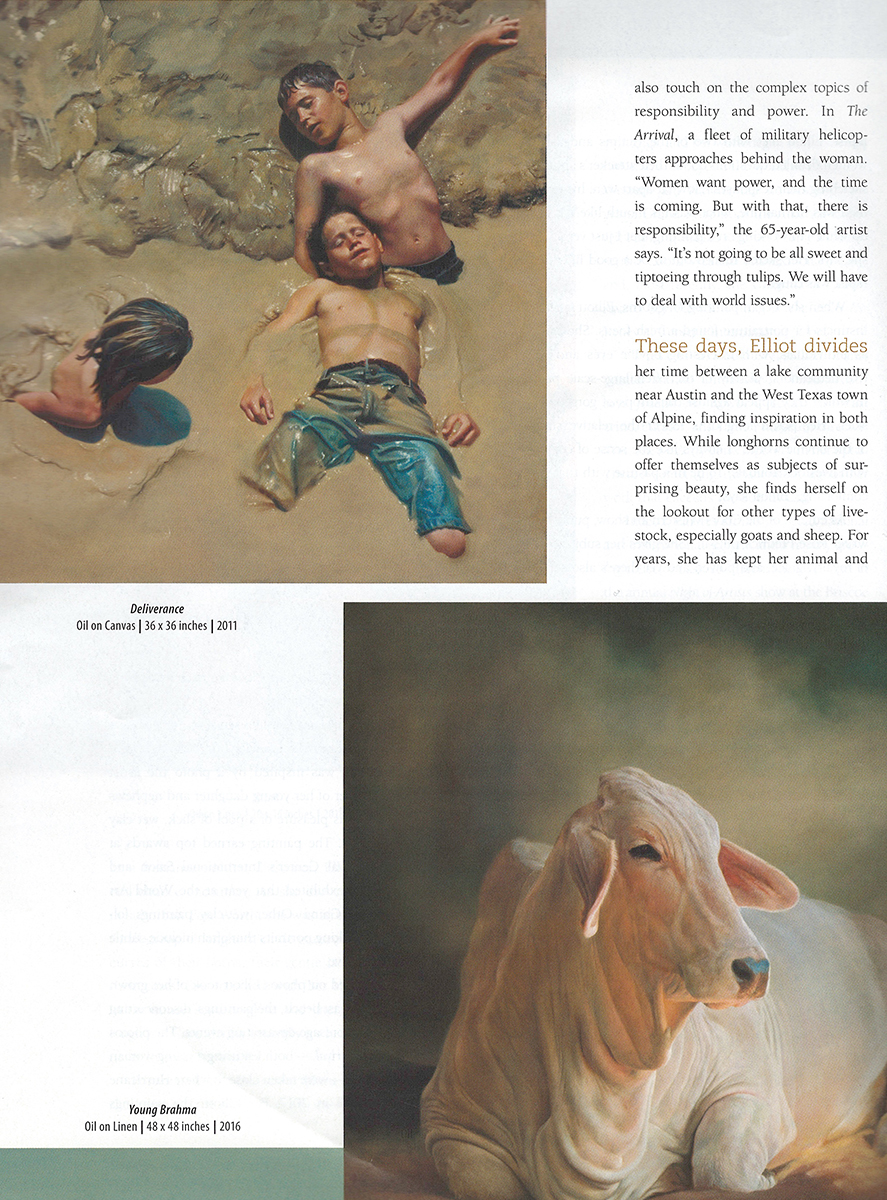
This reference to a Mona Lisa-like sense of intrigue also applies to Elliott’s figurative work. Her first large figurative painting, Deliverance, was inspired by a photo the artist had taken years earlier of her young daughter and nephews enjoying the luxurious pleasure of a pool of slick, wet clay under the Texas sun. The painting earned top awards at the 2012 Art Renewal Center’s International Solon and elsewhere, and was exhibited that year at the World Art Museum in Beijing, China. Other wet-clay paintings followed, along with striking portraits that often include subtle suggestions of narrative.

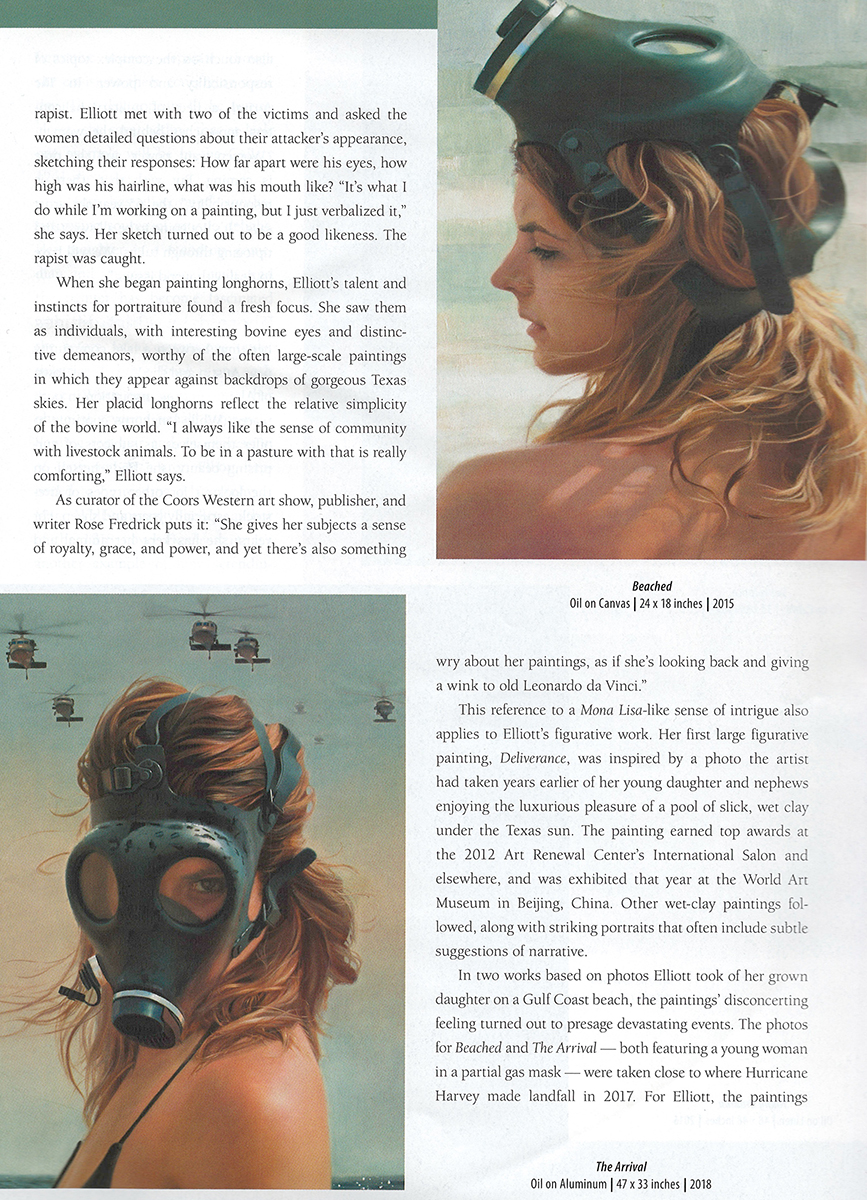
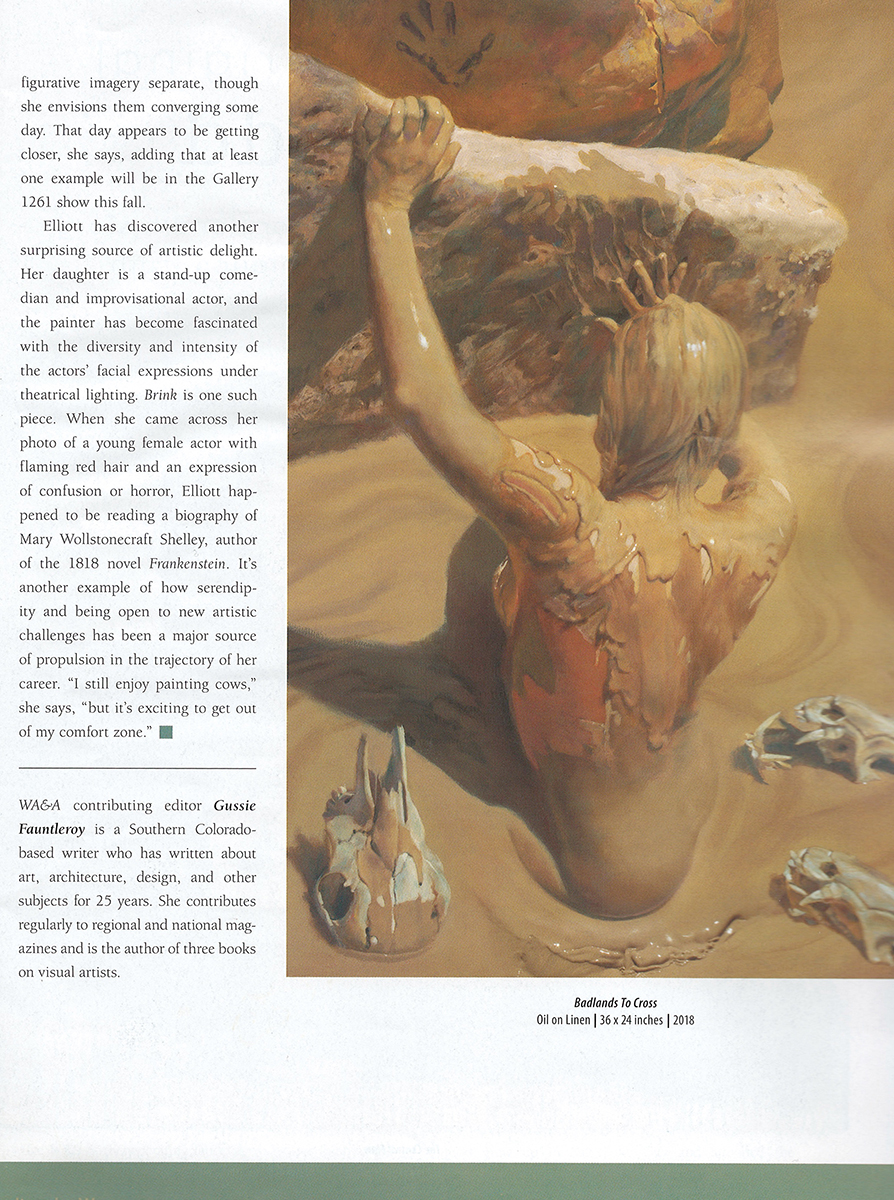
In two works based on photos Elliott took of her grown daughter on a Gulf Coast beach, the paintings’ disconcerting feeling turned out to presage devastating events. The photos for Beached and The Arrival — both featuring a young women in a partial gas mask — were taken close to where Hurricane Harvey made landfall in 2017. For Elliott, the paintings also touch on the complex topics of responsibility and power. In The Arrival, a fleet of military helicopters approaches behind the woman. “Women want power, and the time is coming. But with that, there is responsibility.” the 65-year-old artist says. :It’s not going to be all sweet and tiptoeing through tulips. We will to deal with world issues.”

These days, Elliot divides her time between a lake community near Austin and the West Texas town of Alpine, finding inspiration in both places. While longhorns continue to offer themselves as subjects of surprising beauty, she finds herself on the lookout for other types of livestock, especially goats and sheep. For years, she has kept her animal and figurative imagery separate, though she envisions them converging some day. That day appears to getting closer, she says, adding that at least one example will be in the Gallery 1261 show this fall.

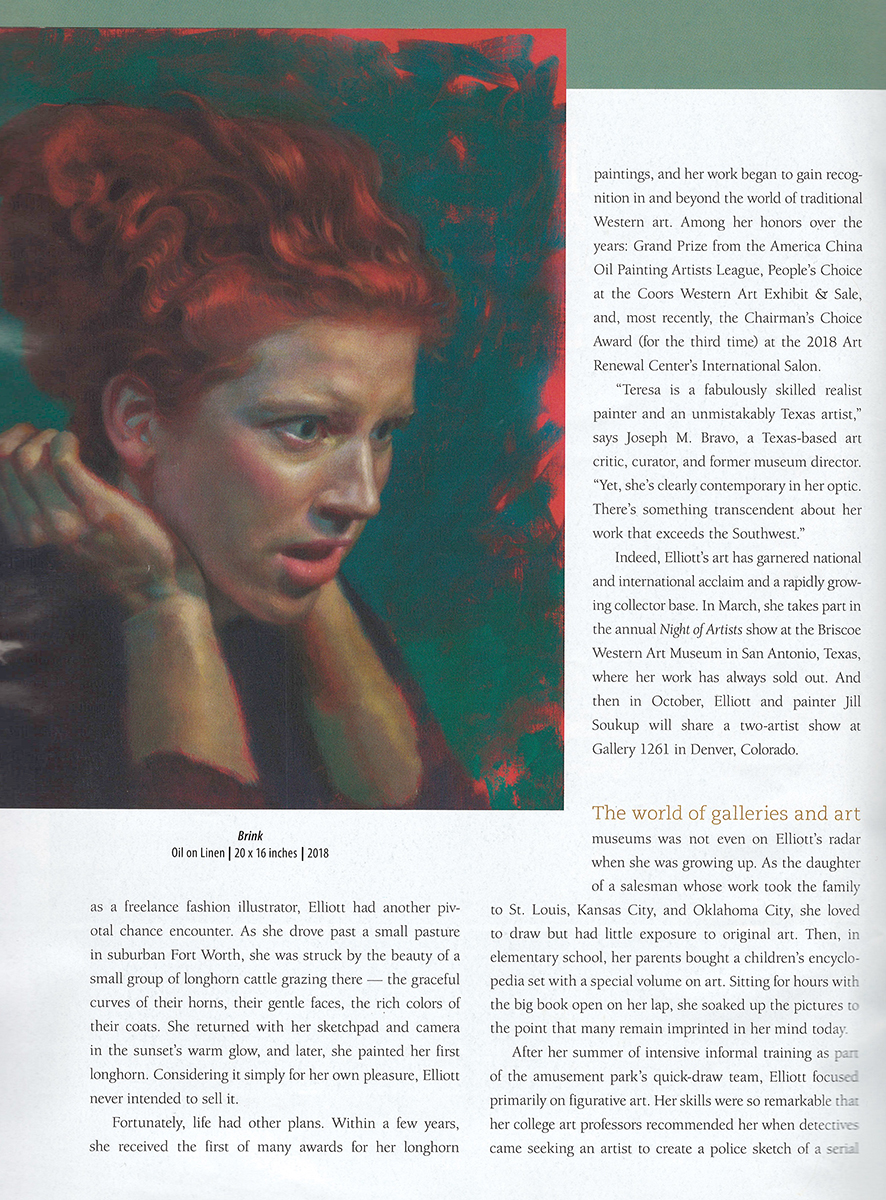
Elliott has discovered another surprising source of artistic delight,. Her daughter is a stand-up comedian and improvisational actor, and the painter has become fascinated with the diversity and intensity of a the actors’ facial expressions under theatrical lighting. Brink is one such piece. When she came across her photo of a young female actors with flaming red hair and an expression of confusion or horror, Elliott happened to be reading a biography of Mary Wollstonecraft Shelley, author of the 1919 novel Frankenstein. It’s another example of how serendipity and being open to new artistic challengers has been a major source of propulsion in the trajectory of her career, “I still enjoy painting cows,” she says, “But it’s exciting to get out of my comfort zone.”

Tags Western Art & Architecture, Teresa Elliott, Livestock, Painting, Texas painter
Maxwell+Alexander+Gallery+Nov+27+2018+A.jpg Coloring+book+full+package.jpg

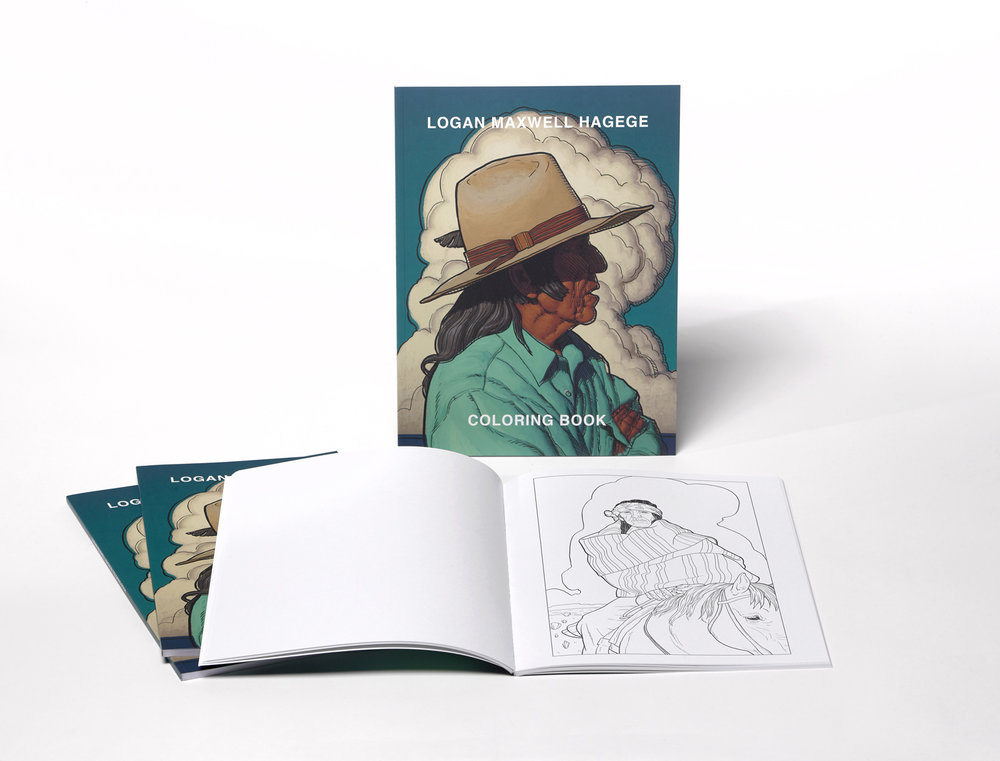
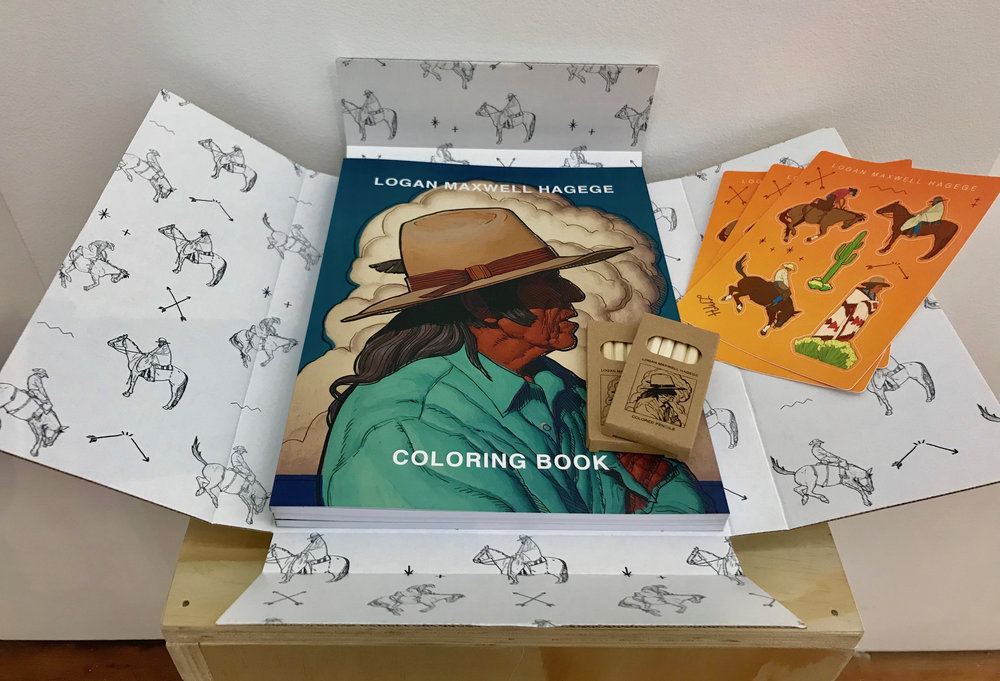
Logan Maxwell Hagege Coloring Books

December 21, 2018

Logan Maxwell Hagege Coloring Book released on Saturday December 1, 2018 at 11am PST exclusively on MaxwellAlexanderGallery.com/shop/ 
The book includes 25 images based on original paintings by Logan Maxwell Hagege. All pictures were recreated by the artist himself to insure quality images on each page. 

Tags Logan Maxwell Hagege, Coloring Book, Western Art
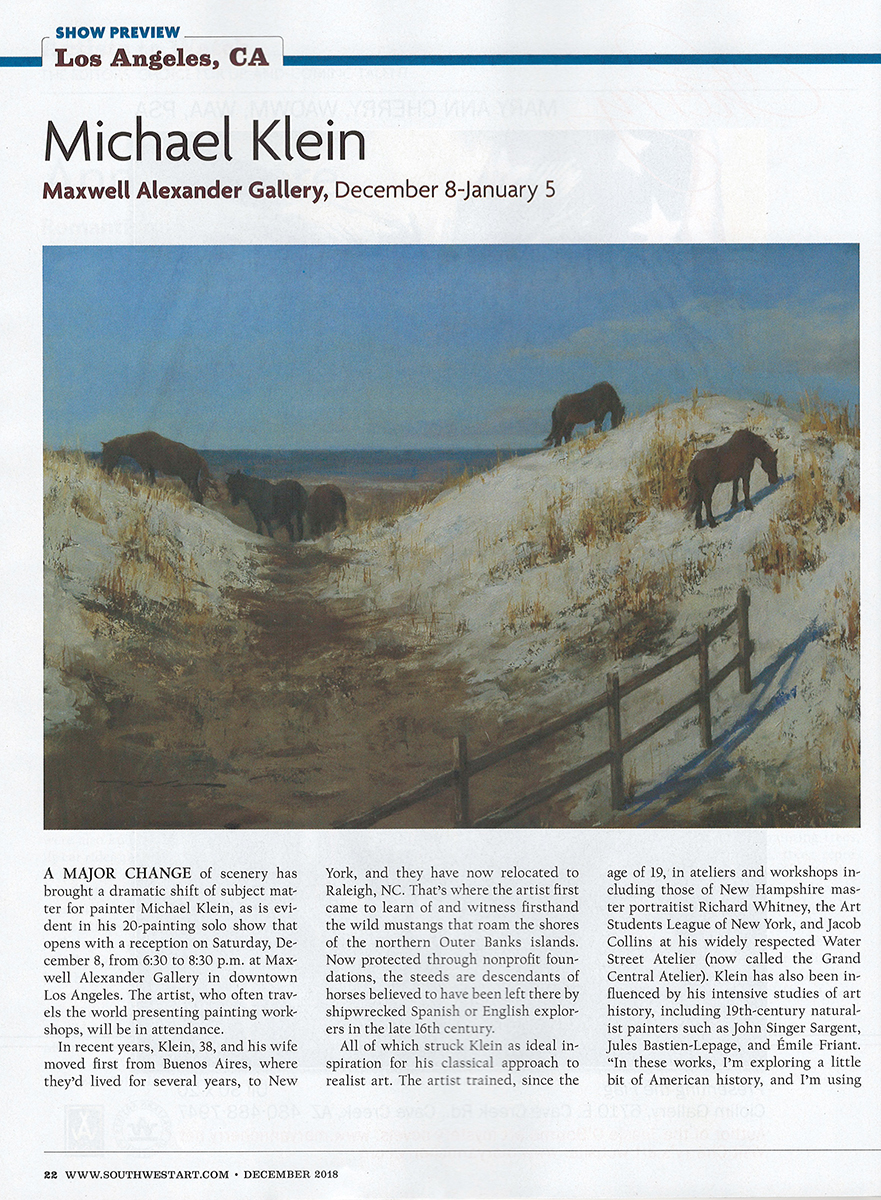
M.Klein-Western-Art-Collector-pg1.jpg M.-Klein-Western-Art-Collector-pg2.jpg

Western Art Collector Magazine's Overview of Upcoming Michael Klein Solo Show

November 17, 2018

Roaming the shores

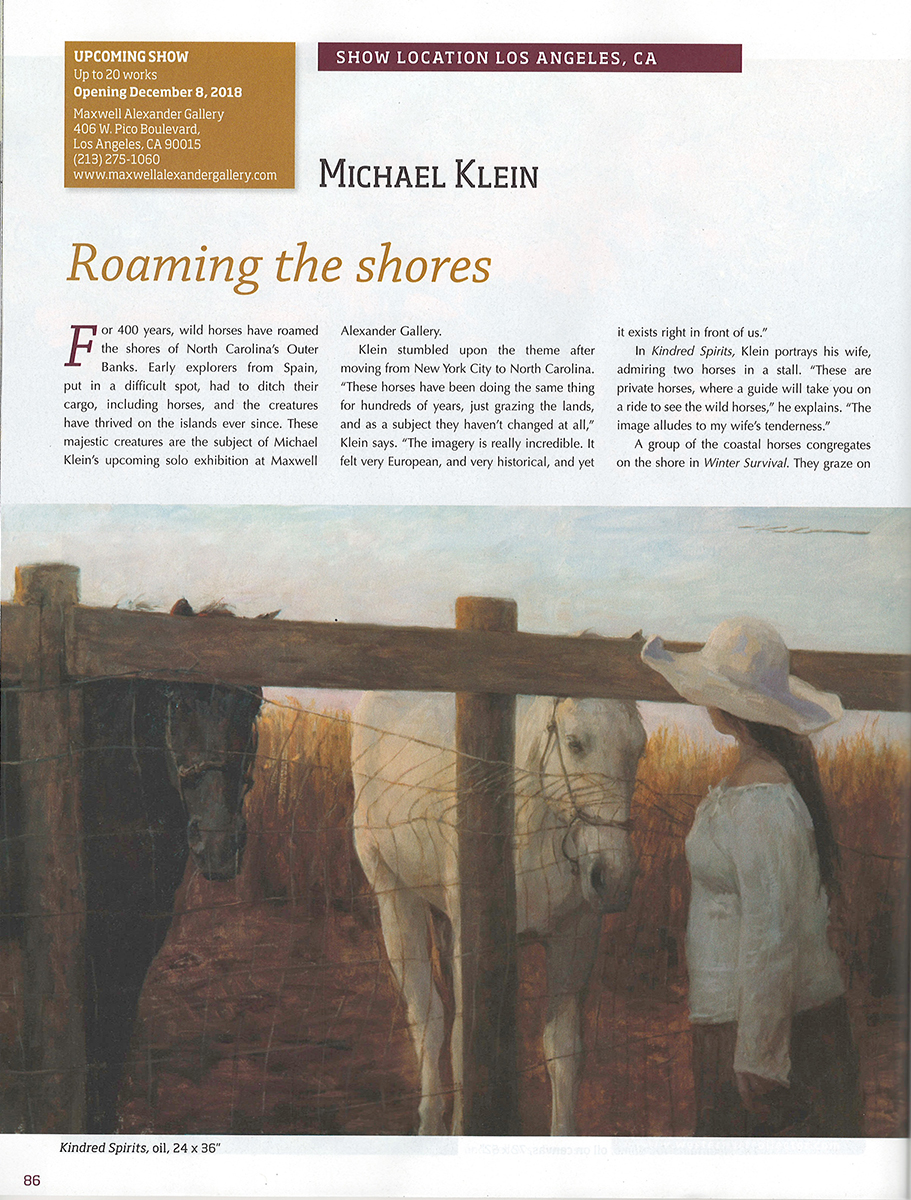
For 400 years, wild horses have roamed the shores of North Carolina’s Outer Banks. Early explorers from Spain, put in a difficult spot, had to ditch their cargo, including horses, and the creatures have thrived on the island ever since. These majestic creatures are the subject of Michael Klein’s upcoming solo exhibition at Maxwell Alexander Gallery.

Klein stumbled upon the theme after moving from New York City to North Carolina. “These horses have been doing the same thing for hundreds of years, just grazing the lands, and as a subject they haven’t changed at all,” Klein says. “The imagery is really incredible. It felt very European, and very historical, and yet it exists right in front of us.”

In Kindred Spirits, Klein portrays his wife, admiring two horses in a stall. “These are private horses, where a guide will take you on a ride to see the wild horses,” he explains. “The image alludes to my wife’s tenderness.”

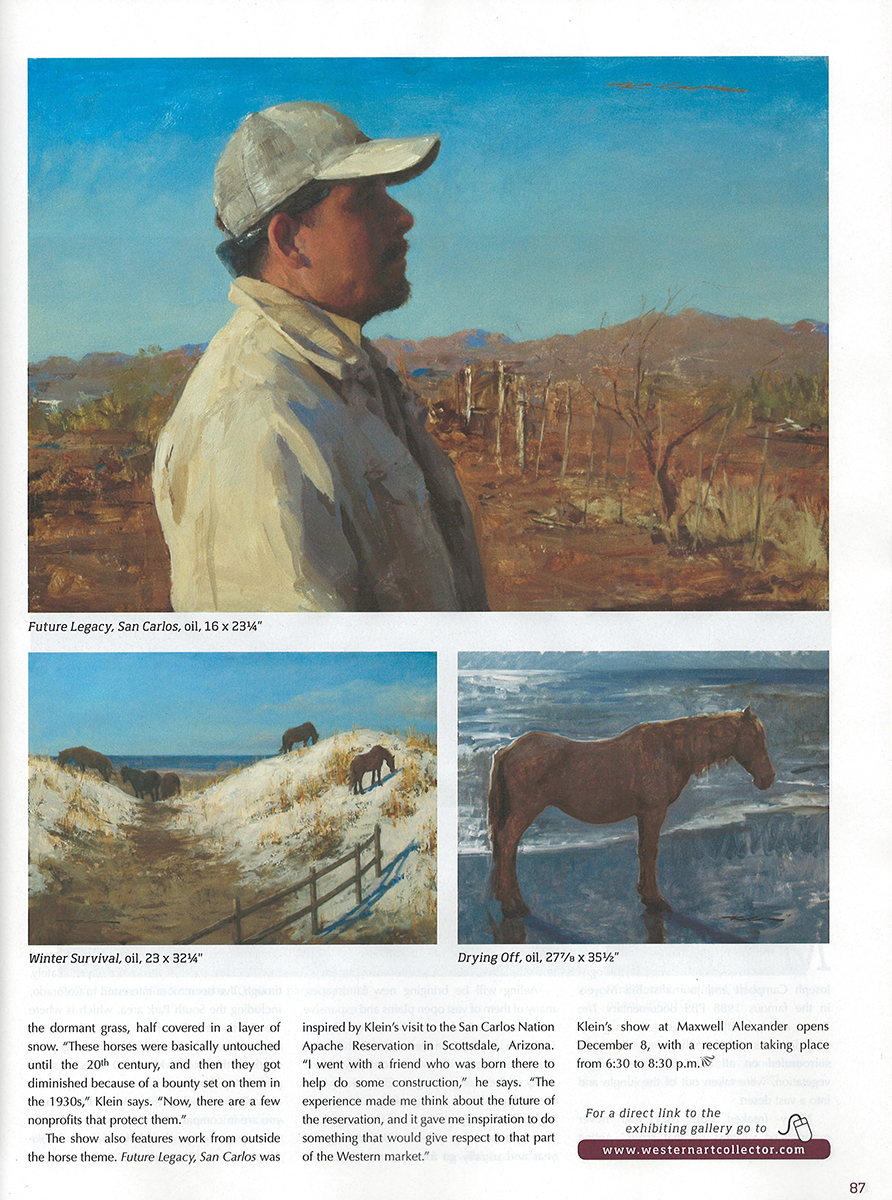
A group of the coastal horses congregates on the shore in Winter Survival. They graze on the dormant grass, half covered in a layer of snow. “These horses were basically untouched until the 20th century, and then they got diminished because of a bounty set on them in the 1930s,” Klein says. “Now, there are a few nonprofits that protect them.”

The show also features work from outside the horse theme. Future Legacy, San Carlos was inspired by Klein’s visit to the San Carlos Nation Apache Reservation in Scottsdale, Arizona. “I went with a friend who was born there to help do some construction,” he says. “The experience made me think about the future of the reservation, and it gave me inspiration to do something that would give respect to that part of the Western market.”

Klein’s show at Maxwell Alexander opens December 8, with a reception taking place from 6:30 to 8:30 p.m.

Tags Western Art Collector Magazine, Western Art, Michael Klein, Contemporary Realism, Horse painting, North Carolina
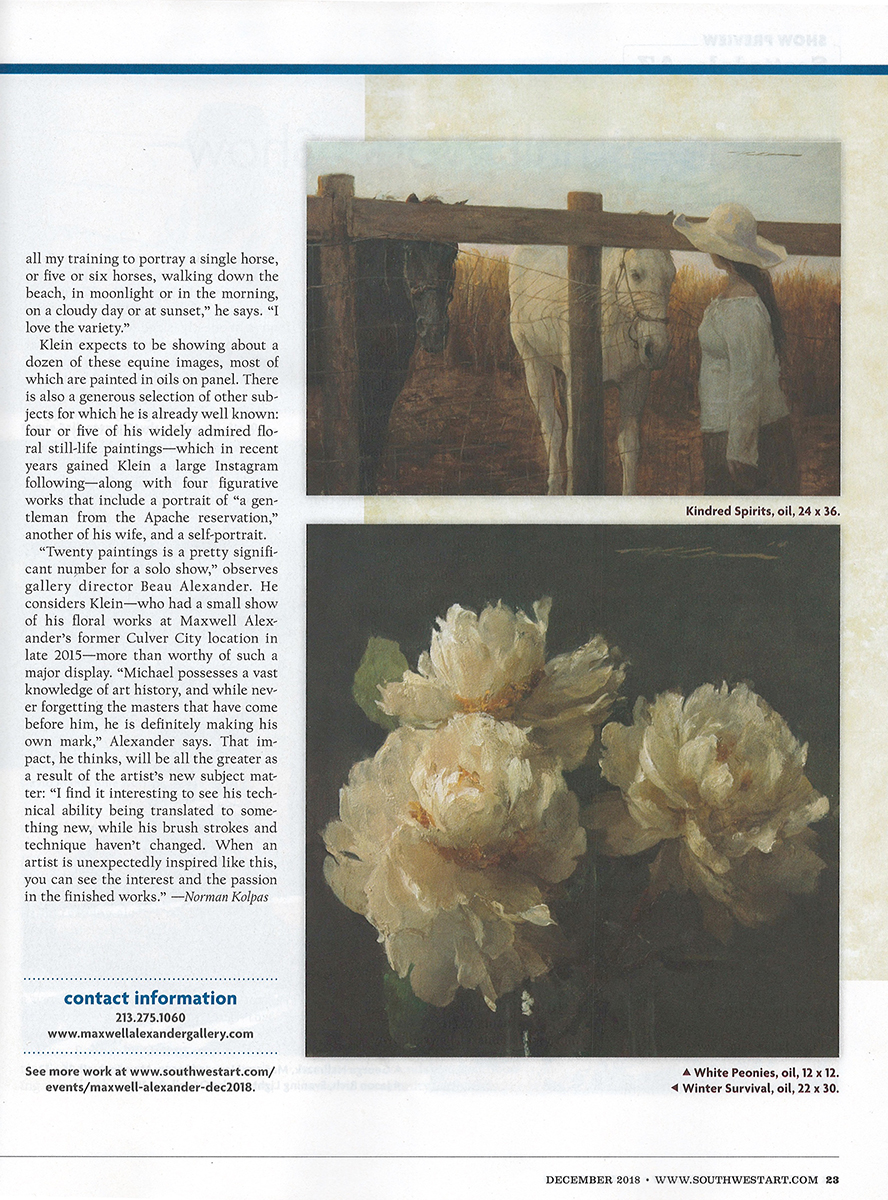
M.Klein-Southwest-art-pg1.jpg M.Klein-Southwest-Art-pg.2.jpg

Southwest Art Magazine Previews the Upcoming Michael Klein Show Land Dwellers

November 17, 2018

Show Preview

A major change of scenery has brought a dramatic shift of subject matter for painter Michael Klein, as is evident in his 20-painting solo show that opens with a reception on Saturday, December 8, from 6:30 to 8:30 p.m. at Maxwell Alexander Gallery in downtown Los Angeles. The artist, who often travels the world presenting painting workshops, will be in attendance.

In recent years, Klein, 38, and his wife moved first from Buenos Aires, where they’d lived for several years, to New York, and they have now relocated to Raleigh, NC. That’s where the artist first came to learn of and witness firsthand the wild mustangs that roam the shores of the northern Outer Banks islands. Now protected through nonprofit foundations, the steeds are descendants of horses believed to have been left there by shipwrecked Spanish or English explorers in the late 16th century.
All of which struck Klein as ideal inspiration for his classical approach to realist art. The artist trained, since the age of 19, in ateliers and workshops including those of New Hampshire master portraitist Richard Whitney, the Art Students League of New York, and Jacob Collins at his widely respected Water Street Atelier (now called the Grand Central Atelier). Klein has also been influenced by his intensive studies of art history, including 19th-century naturalist painters such as John Singer Sargent, Jules Bastien-Lepage, and Émile Friant. “In these works, I’m exploring a little bit of American history, and I’m using all my training to portray a single horse, or five or six horses, walking down the beach, in moonlight or in the morning, on a cloudy day or at sunset,” he says. “I love the variety.”

Klein expects to be showing about a dozen of these equine images, most of which are painted in oils on panel. There is also a generous selection of other subjects for which he is already well known: four or five of his widely admired floral still-life paintings—which in recent years gained Klein a large Instagram following—along with four figurative works that include a portrait of “a gentleman from the Apache reservation,” another of his wife, and a self-portrait.

“Twenty paintings is a pretty significant number for a solo show,” observes gallery director Beau Alexander. He considers Klein—who had a small show of his floral works at Maxwell Alexander’s former Culver City location in late 2015—more than worthy of such a major display. “Michael possesses a vast knowledge of art history, and while never forgetting the masters that have come before him, he is definitely making his own mark,” Alexander says. That impact, he thinks, will be all the greater as a result of the artist’s new subject matter: “I find it interesting to see his technical ability being translated to something new, while his brush strokes and technique haven’t changed. When an artist is unexpectedly inspired like this, you can see the interest and the passion in the finished works.”

Tags Southwest Art Magazine, Solo exhibition, Western Art, Floral painting, Contemporary Realism, Horse painting, North Carolina, Michael Klein
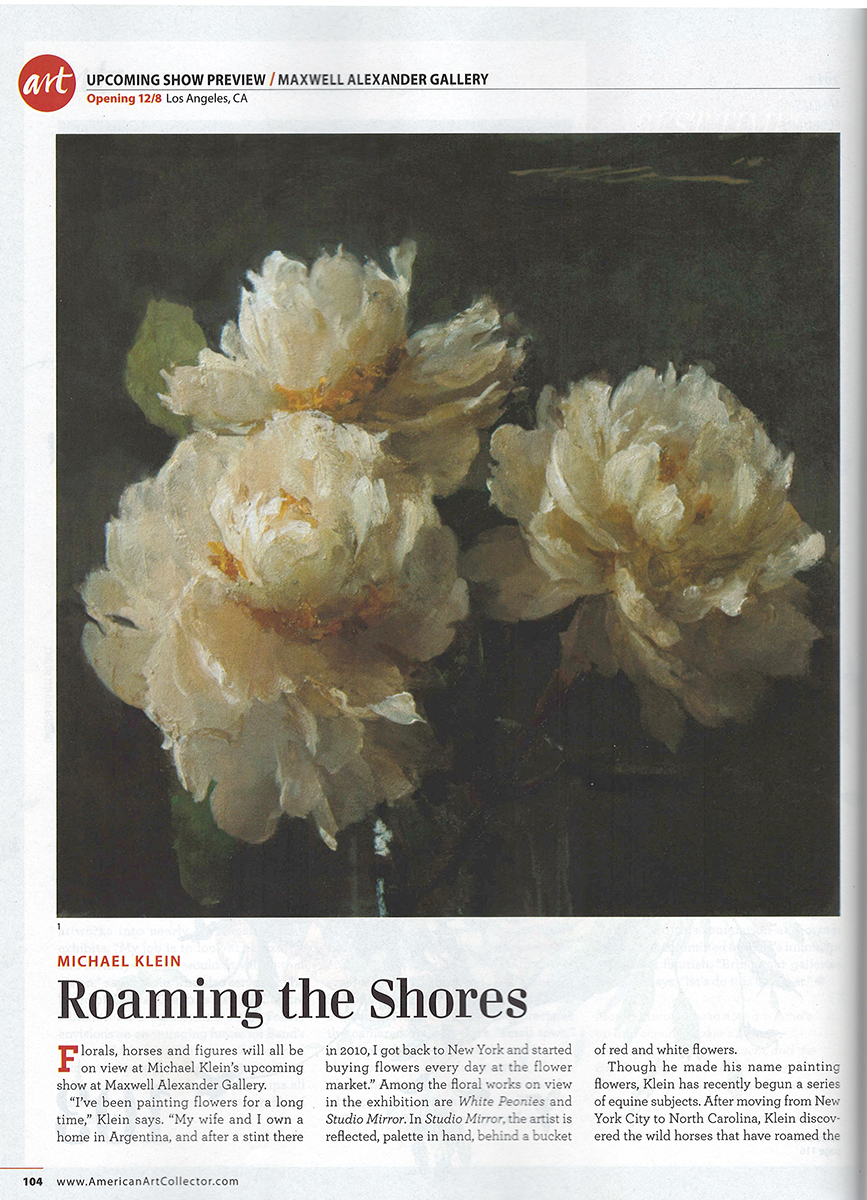
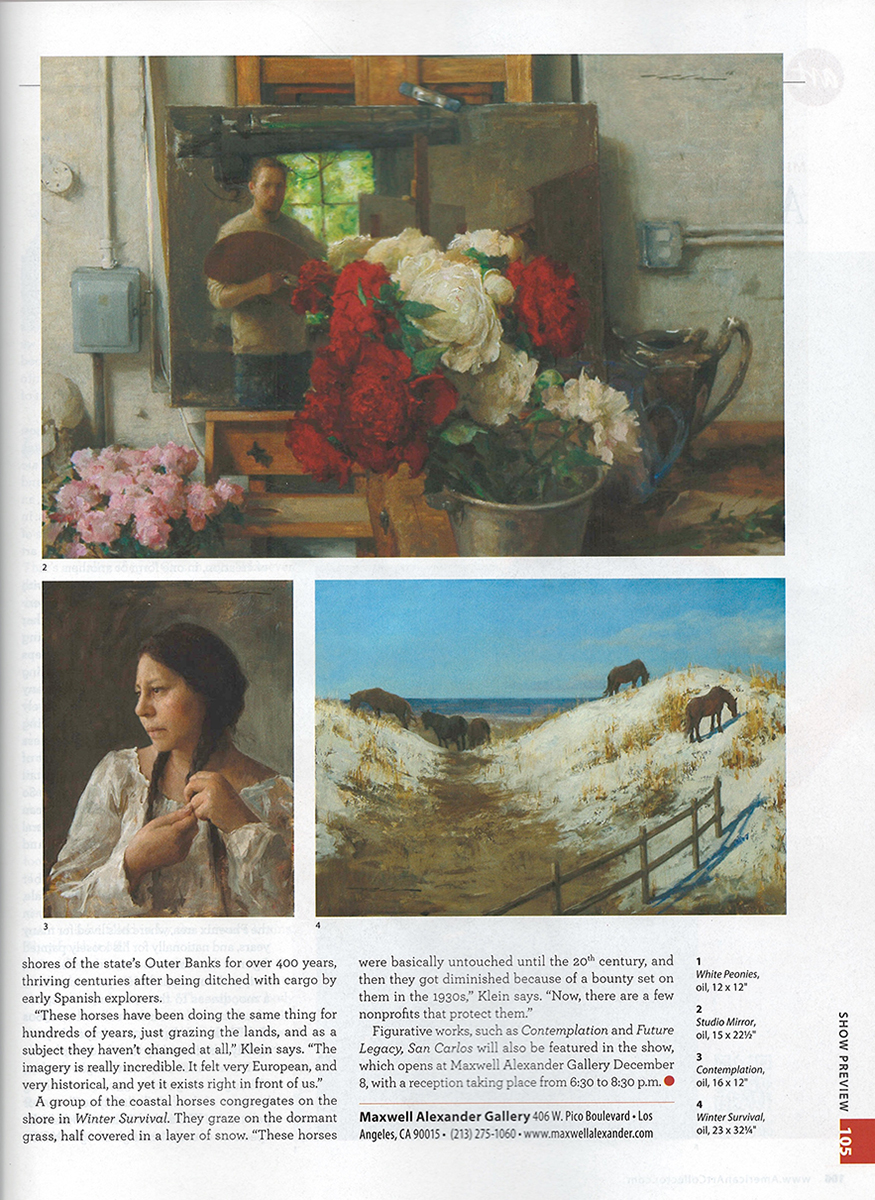
M.-Klein-American-Art-pg1.jpg M.-Klein-American-art-pg2.jpg

American Art Collector Magazine Previews Land Dwellers, Michael Klein's Upcoming Solo Exhibition

November 17, 2018

Roaming the Shores

Florals, horses and figures will all be on view at Michael Klein’s upcoming show at Maxwell Alexander Gallery. “I’ve been painting flowers for a long time,” Klein says. “My wife and I own a home in Argentina, and after a stint there in 2010, I got back to New York and started buying flowers every day at the flower market.” Among the floral works on view in the exhibition are White Peonies and Studio Mirror. In Studio Mirror, the artist is reflected, palette in hand, behind a bucket of red and white flowers.

Though he made his name painting flowers, Klein has recently begun a series of equine subjects. After moving from New York City to North Carolina, Klein discovered the wild horses that have roamed the shores of the state’s Outer Banks for over 400 years, thriving centuries after being ditched with cargo by early Spanish explorers.

“These horses have been doing the same thing for hundreds of years, just grazing the lands, and as a subject they haven’t changed at all,” Klein says. “The imagery is really incredible. It felt very European, and very historical, and yet it exists right in front of us.”

A group of the coastal horses congregates on the shore in Winter Survival. They graze on the dormant grass, half covered in a layer of snow. “These horses were basically untouched until the 20th century, and then they got diminished because of a bounty set on them in the 1930s,” Klein says. “Now, there are a few nonprofits that protect them.”

Figurative works, such as Contemplation and Future Legacy, San Carlos will also be featured in the show, which opens at Maxwell Alexander Gallery December 8, with a reception taking place from 6:30 to 8:30 p.m.

Tags American Art Collector Magazine, Floral painting, Portrait, Horse painting, Solo exhibition, Michael Klein
DannyGalieote1.jpg

Western Art Collector Magazine Interviews Danny Galieote on upcoming exhibition

October 19, 2018

Modern Americana


With his statuesque, Pop Art figures, Danny Galieote creates paintings that feel timeless. At Maxwell Alexander Gallery in Los Angeles, he will show his works in a solo exhibition that takes place November 3 through 25.

Afternoon Pastoral is a farm panorama that exemplifies the American Dream, showing men and women working the land to put food on the table for their families. “It’s a cinematic film pan across the farm,” explains Galieote. “It’s only 43 inches, but I can imagine it being 43 feet, as a grand landscape with those sculpturesque figures.”

Galieote is inspired by the 1930s, ‘40s and ‘50s. “My mom’s dad was in the Navy during those times and traveled the world. He would tell me those stories when I was a kid, so I feel like I sort of grew up in that era.”

The artwork of the time was incredibly touched by the Works Progress Administration, which commissioned artists to complete thousands of murals. “Murals read well from a distance when they are well designed, and they have a sense of flow and fluidity. That’s really what I’m going for,” the artist says.

Featuring a crowing rooster, Country Morning harkens back to a simpler time. Galieote grew up in Los Angeles, but on a small farm with horses and chickens. “Every morning at 5 o’clock I’d wake up to Mean Joe,” he laughs. “Even though I was living in contemporary, modern LA, my childhood had a really traditional Americana feel.”

Tags Western Art Collector Magazine, Western Art, Danny Galieote, Americana
BrettAllanJohnson1.jpg BrettAllenJohnson2.jpg

Western Art Collector Magazine Previews Brett Allen Johnson Showcase

October 18, 2018

Interpreting the Southwest


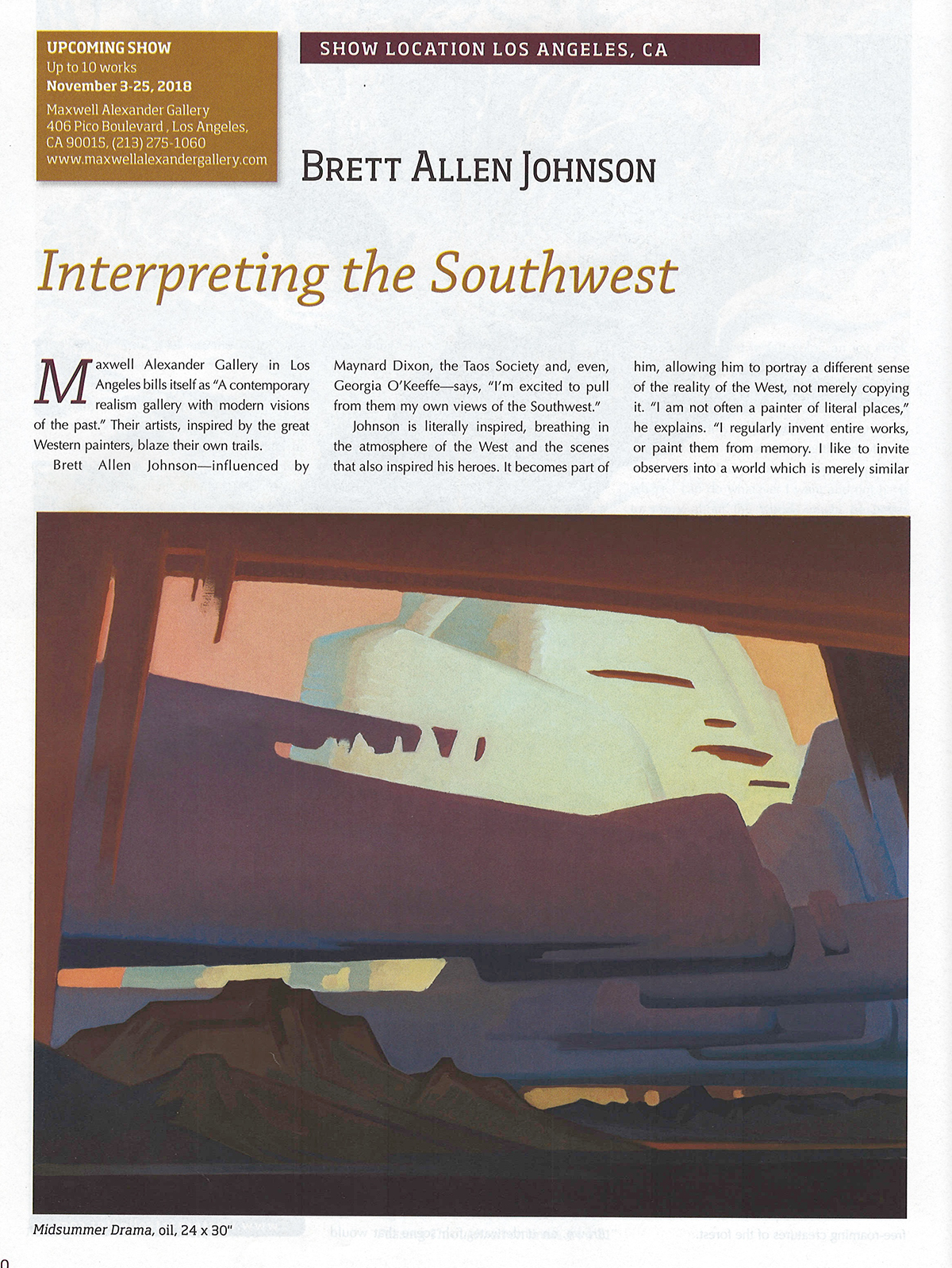
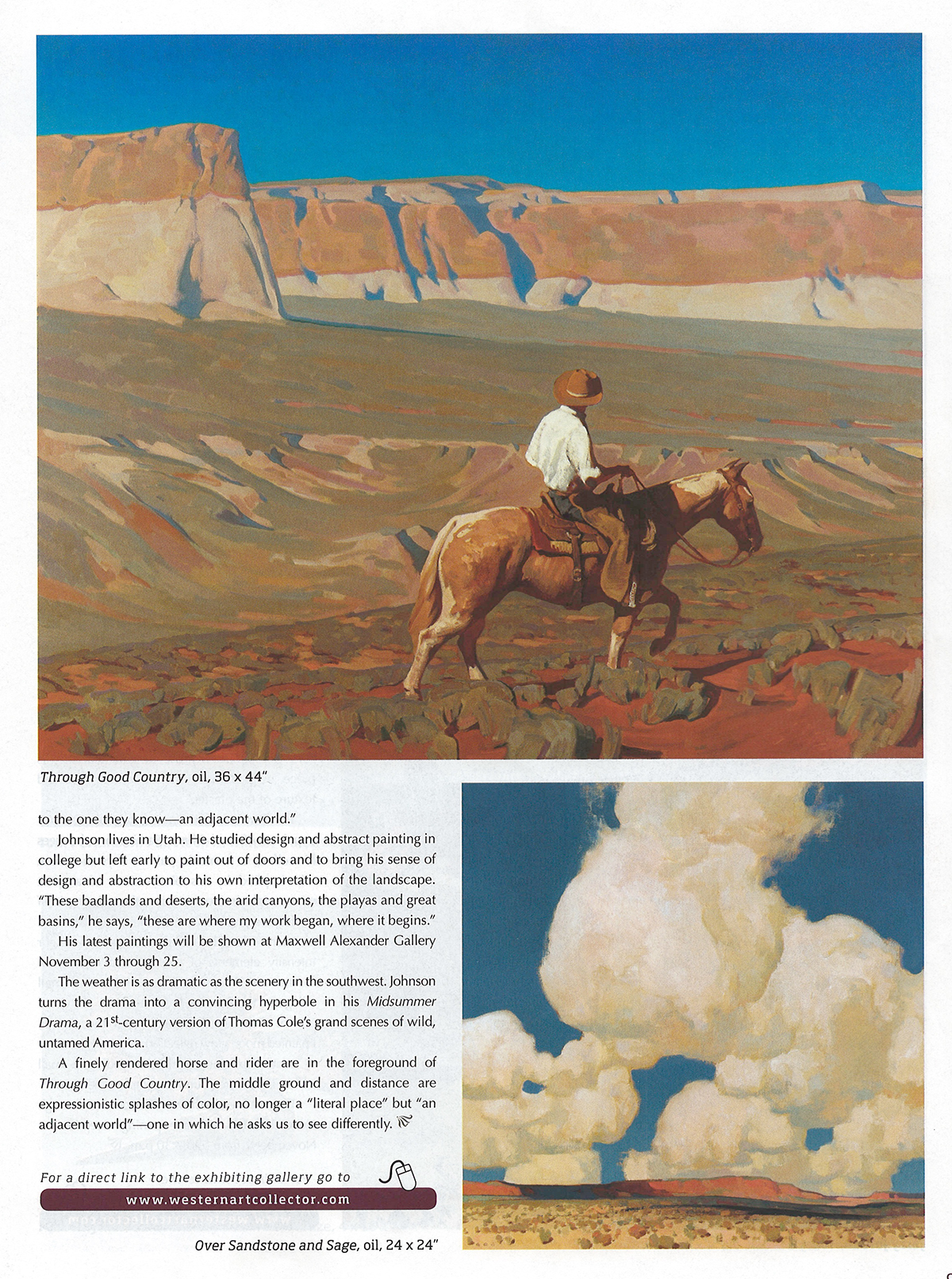
Maxwell Alexander Gallery in Los Angeles bills itself as “A contemporary realism gallery with modern visions of the past.” Their artists, inspired by the great Western painters, blaze their own trails. Brett Allen Johnson—influenced by Maynard Dixon, the Taos Society and even, Georgia O’Keefe— says, “I’m excited to pull from them my own views of the Southwest.” Johnson is literally inspired, breathing in the atmosphere of the West and the scenes that also inspired his heroes. It becomes part of him, allowing him to portray a different sense of the reality of the West, not merely copying it. “I am not often a painter of literal places,” he explains. “I regular invent entire works, or paint them from memory. I like to invite observers into a world which is merely similar to the one they know—an adjacent world.”

Johnson lives in Utah. He studied design and abstract painting in college but left early to paint out of doors and to bring his sense of design and abstraction to his own interpretation of the landscape. “These badlands and deserts, the arid canyons, the playas and great basins,” he says, “these are where my work began, where it begins.”

His latest paintings will be shown at Maxwell Alexander Gallery November 3 through 25.

The weather is a dramatic as the scenery in the southwest. Johnson turns the drama into a convincing hyperbole in his Midsummer Drama, a 21st-century version of Thomas Cole’s grand scenes of wild, untamed America.

A finely rendered horse and rider are in the foreground of Through Good County. The middle ground and distance are expressionistic splashes of color, no longer a “literal place” but “an adjacent world”—one in which he asks us to see differently.

Tags Western Art Collector Magazine, Western Art, Southwest inspiration, Landscape painting
Screen Shot 2018-10-19 at 12.39.19 PM.png

Grant Redden's cover of Western Art Collector Magazine

October 18, 2018

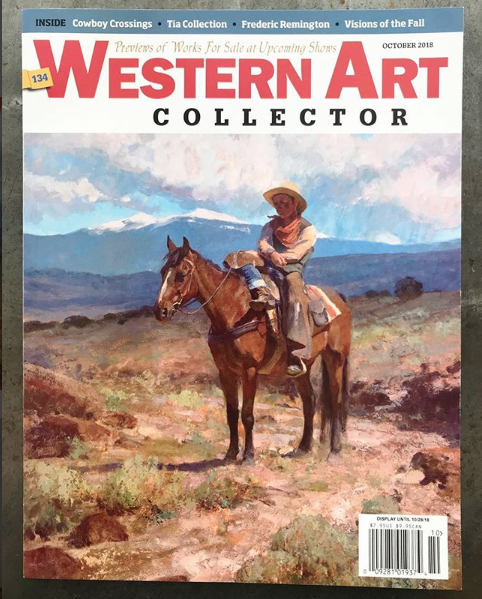
Congratulations to Grant Redden for landing the cover of Western Art Collector magazine for October 2018. Be on the lookout for a show of his new paintings at our gallery this coming Spring 2019.

Tags Western Art Collector Magazine, Western Art, Grant Redden, Coverpage, Cowboy paintings
PRE-Natalie Featherston1.jpg PRE-Natalie Featherston2.jpg

Western Art Collector Magazine Previews Natalie Featherston exhibition

October 18, 2018

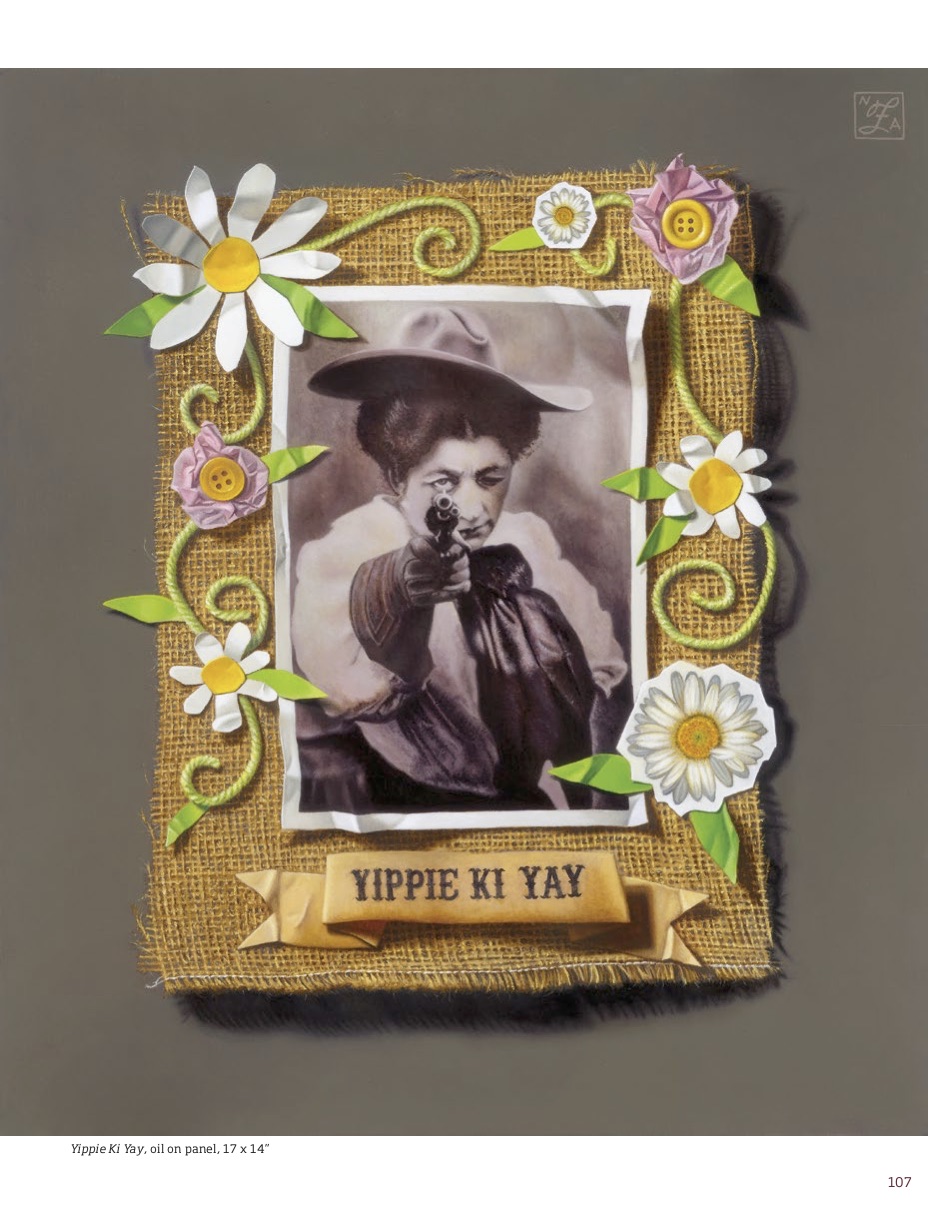
Artful dodger

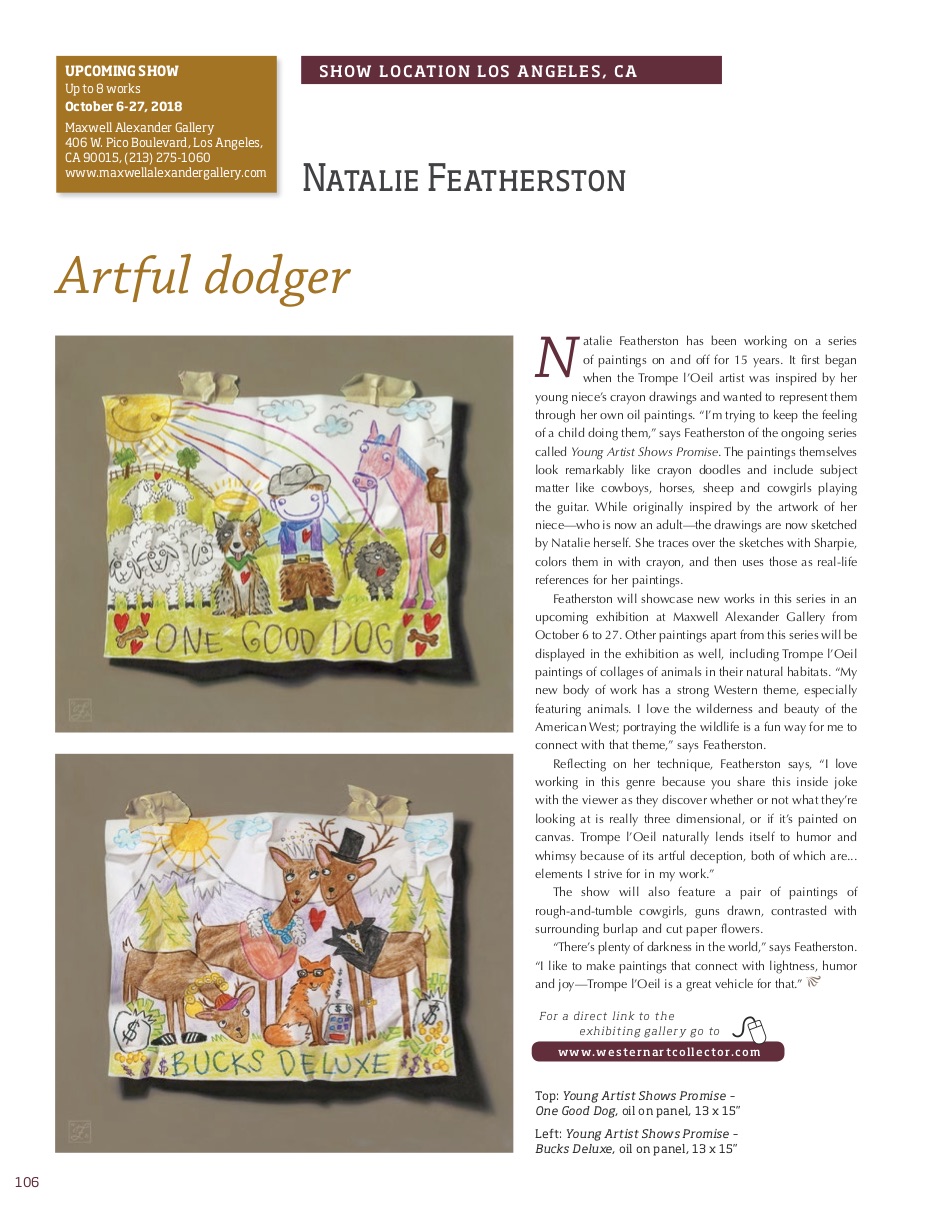
Natalie Featherston has been working on a series of paintings on and off for 15 years. It first began when the Trompe l’Oeil artist was inspired by her young niece’s crayon drawings and wanted to represent them through her own oil paintings. “I’m trying to keep the feeling of a child doing them,” says Featherston of the ongoing series called Young Artist Shows Promise. The paintings themselves look remarkably like crayon doodles and include subject matter like cowboys, horses, sheep and cowgirls playing the guitar. While originally inspired by the artwork of her niece—who is now an adult—the drawings are now sketched by Natalie herself. She traces over the sketches with Sharpie, colors them in with crayon, and then uses those as real-life references for her paintings.

Featherston will showcase new works in this series in an upcoming exhibition at Maxwell Alexander Gallery from October 6 to 27. Other paintings apart from this series will be displayed in the exhibition as well, including Trompe l’Oeil paintings of collages of animals in their natural habitats. “My new body of work has a strong Western theme, especially featuring animals. I love the wilderness and beauty of the American West; portraying the wildlife is a fun way for me to connect with that theme,” says Featherston.

Reflecting on her technique, Featherston says, “I love working in this genre because you share this inside joke with the viewer as they discover whether or not what they’re looking at is really three dimensional, or if it’s painted on canvas. Trompe l’Oeil naturally lends itself to humor and whimsy because of its artful deception, both of which are... elements I strive for in my work.”

The show will also feature a pair of paintings of rough-and-tumble cowgirls, guns drawn, contrasted with surrounding burlap and cut paper flowers.

“There’s plenty of darkness in the world,” says Featherston. “I like to make paintings that connect with lightness, humor and joy—Trompe l’Oeil is a great vehicle for that.”

Tags Western Art Collector Magazine, Western Art, Natalie Featherston, Crayon Drawing Inspiration
Mian Situ_PRE1.jpg Mian Situ_PRE2.jpg

Western Art Collector Magazine Previews Mian Situ Exhibition

October 18, 2018

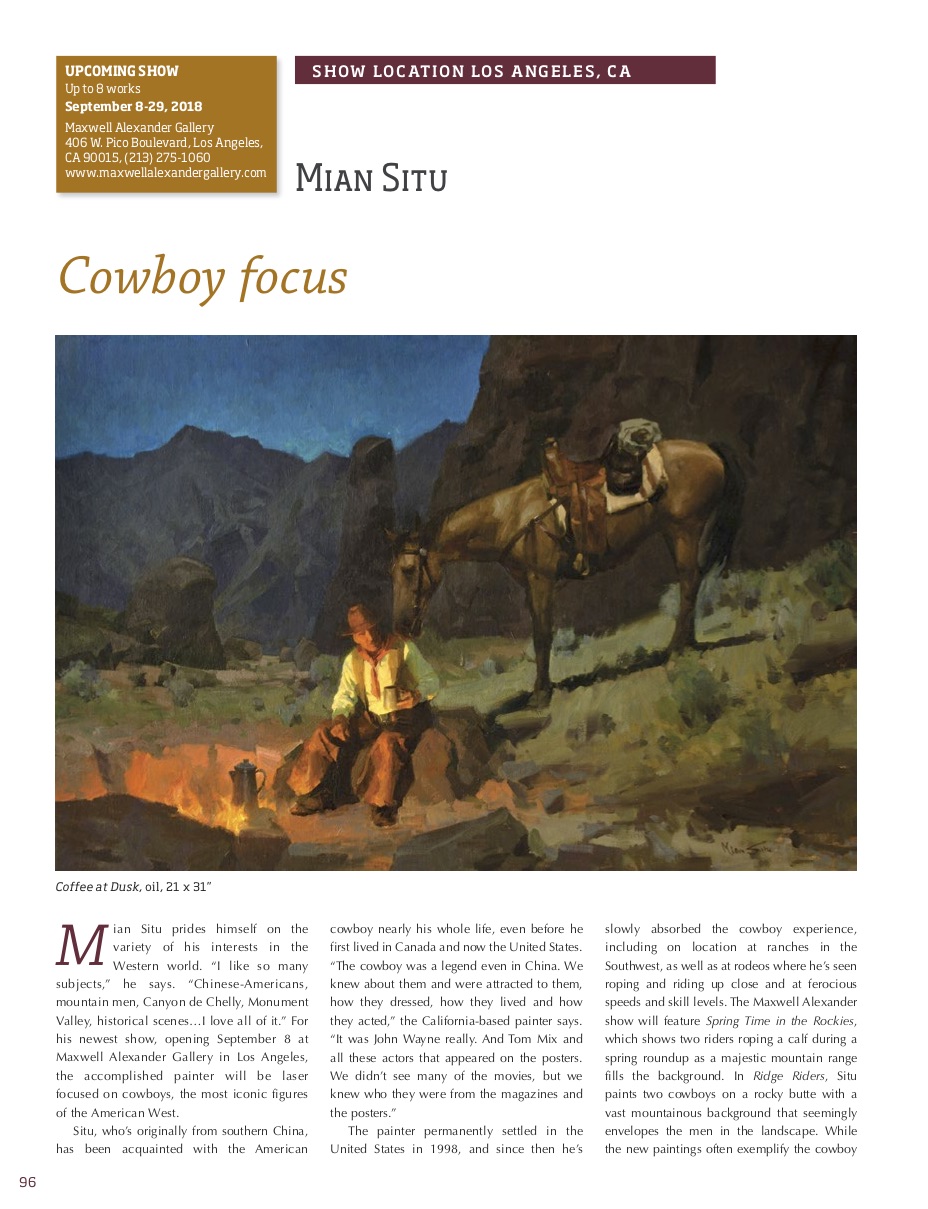
Cowboy focus

Mian Situ prides himself on the variety of his interests in the Western world. “I like so many subjects,” he says. “Chinese-Americans, mountain men, Canyon de Chelly, Monument Valley, historical scenes...I love all of it.” For his newest show, opening September 8 at Maxwell Alexander Gallery in Los Angeles, the accomplished painter will be laser focused on cowboys, the most iconic figures of the American West.

Situ, who’s originally from southern China, has been acquainted with the American cowboy nearly his whole life, even before he first lived in Canada and now the United States. “The cowboy was a legend even in China. We knew about them and were attracted to them, how they dressed, how they lived and how they acted,” the California-based painter says. “It was John Wayne really. And Tom Mix and all these actors that appeared on the posters. We didn’t see many of the movies, but we knew who they were from the magazines and the posters.”

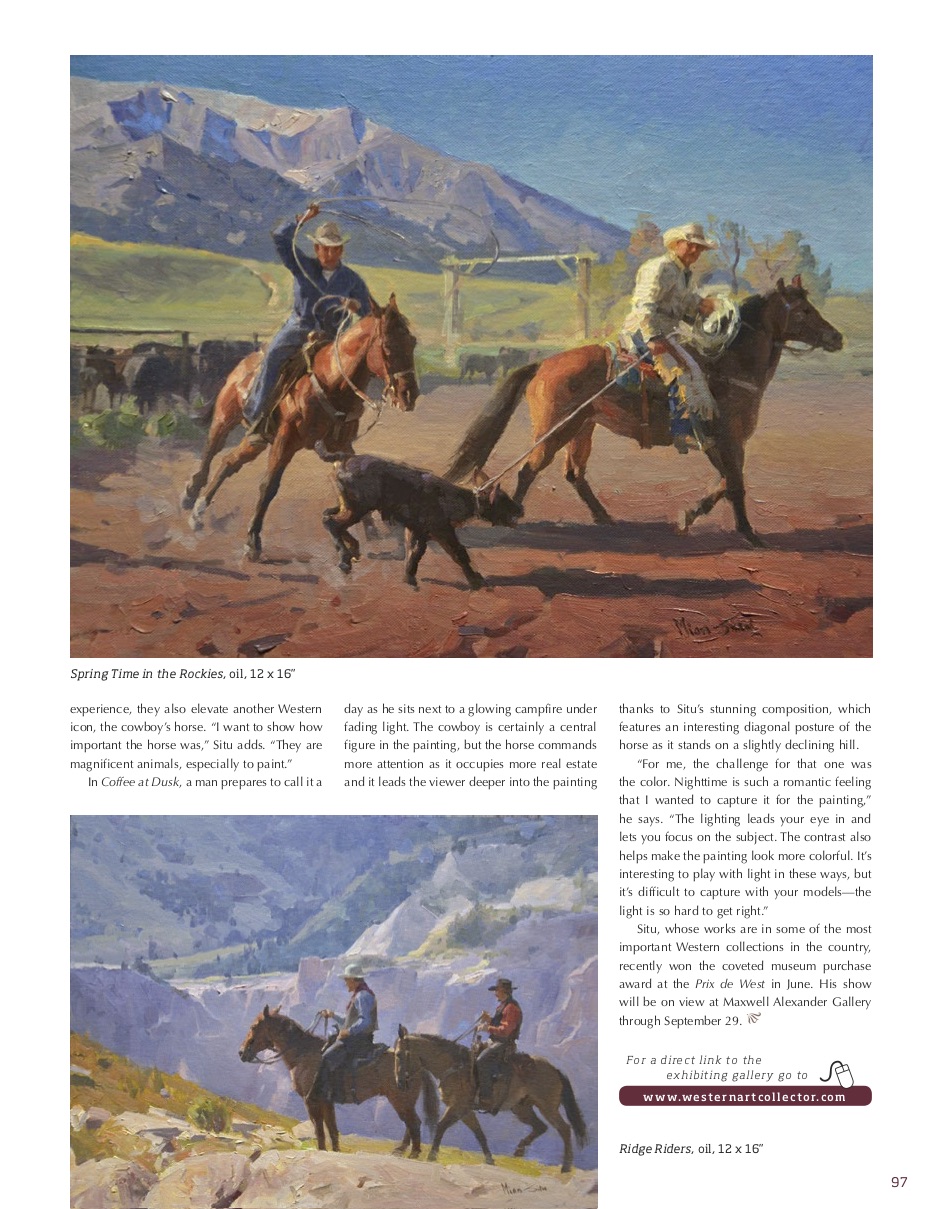
The painter permanently settled in the United States in 1998, and since then he’s slowly absorbed the cowboy experience, including on location at ranches in the Southwest, as well as at rodeos where he’s seen roping and riding up close and at ferocious speeds and skill levels. The Maxwell Alexander show will feature Spring Time in the Rockies, which shows two riders roping a calf during a spring roundup as a majestic mountain range fills the background. In Ridge Riders, Situ paints two cowboys on a rocky butte with a vast mountainous background that seemingly envelopes the men in the landscape. While the new paintings often exemplify the cowboy experience, they also elevate another Western icon, the cowboy’s horse. “I want to show how important the horse was,” Situ adds. “They are magnificent animals, especially to paint.”

In Coffee at Dusk, a man prepares to call it a day as he sits next to a glowing campfire under fading light. The cowboy is certainly a central figure in the painting, but the horse commands more attention as it occupies more real estate and it leads the viewer deeper into the painting thanks to Situ’s stunning composition, which features an interesting diagonal posture of the horse as it stands on a slightly declining hill.

“For me, the challenge for that one was the color. Nighttime is such a romantic feeling that I wanted to capture it for the painting,” he says. “The lighting leads your eye in and lets you focus on the subject. The contrast also helps make the painting look more colorful. It’s interesting to play with light in these ways, but it’s difficult to capture with your models—the light is so hard to get right.”

Situ, whose works are in some of the most important Western collections in the country, recently won the coveted museum purchase award at the Prix de West in June. His show will be on view at Maxwell Alexander Gallery through September 29.

Tags Western Art Collector Magazine, Western Art, Mian Situ, Cowboy paintings
Preview Jeremy Mann1.jpg Preview Jeremy Mann2.jpg

American Art Collector Magazine Previews Jeremy Mann Solo Show

October 18, 2018

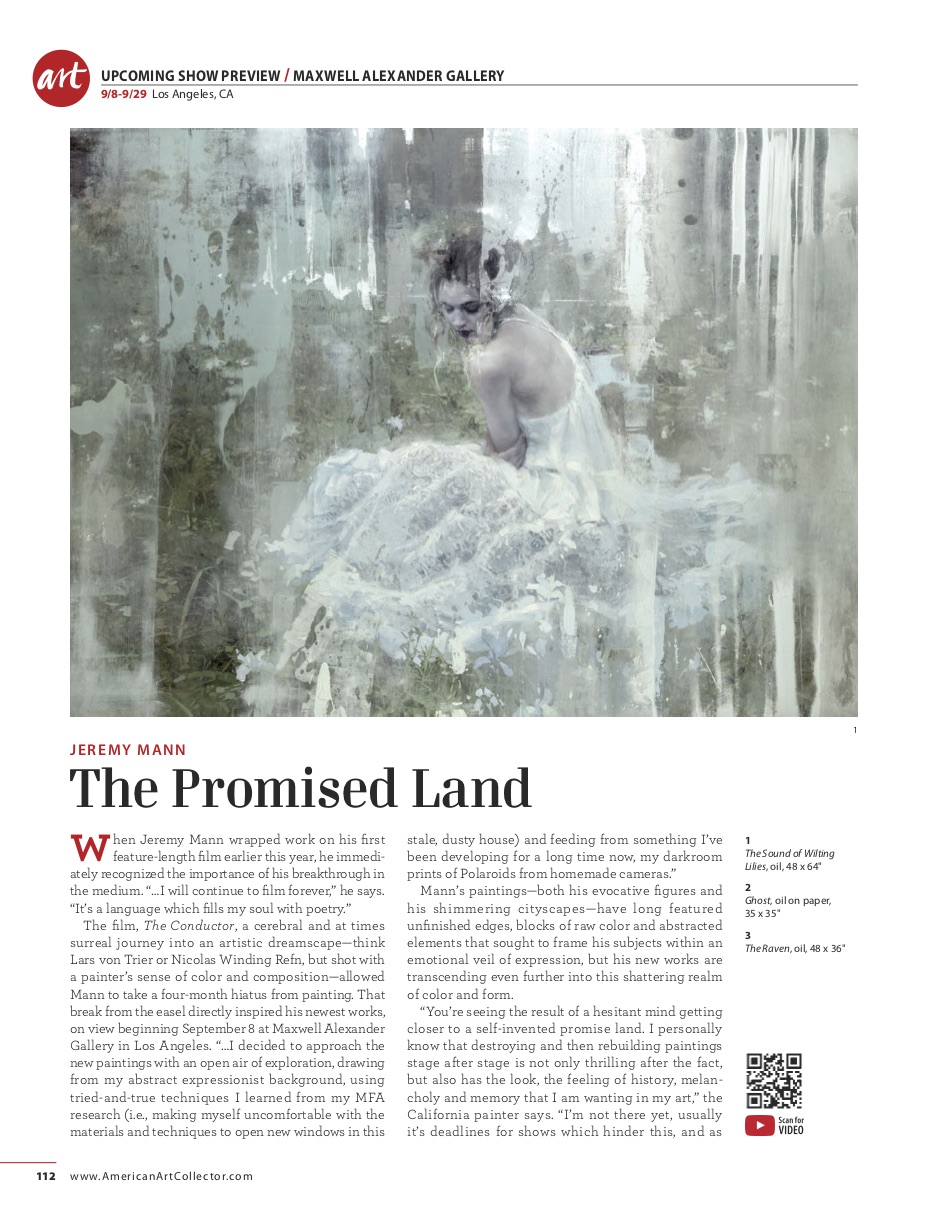
The Promise Land

When Jeremy Mann wrapped work on his first feature-length film earlier this year, he immedi- ately recognized the importance of his breakthrough in the medium. “...I will continue to film forever,” he says. “It’s a language which fills my soul with poetry.”

The film, The Conductor, a cerebral and at times surreal journey into an artistic dreamscape—think Lars von Trier or Nicolas Winding Refn, but shot with a painter’s sense of color and composition—allowed Mann to take a four-month hiatus from painting. That break from the easel directly inspired his newest works, on view beginning September 8 at Maxwell Alexander Gallery in Los Angeles. “...I decided to approach the new paintings with an open air of exploration, drawing from my abstract expressionist background, using tried-and-true techniques I learned from my MFA research (i.e., making myself uncomfortable with the materials and techniques to open new windows in this stale, dusty house) and feeding from something I’ve been developing for a long time now, my darkroom prints of Polaroids from homemade cameras.”

Mann’s paintings—both his evocative figures and his shimmering cityscapes—have long featured unfinished edges, blocks of raw color and abstracted elements that sought to frame his subjects within an emotional veil of expression, but his new works are transcending even further into this shattering realm of color and form.

“You’re seeing the result of a hesitant mind getting closer to a self-invented promise land. I personally know that destroying and then rebuilding paintings stage after stage is not only thrilling after the fact, but also has the look, the feeling of history, melan- choly and memory that I am wanting in my art,” the California painter says. “I’m not there yet, usually it’s deadlines for shows which hinder this, and as you say, you can see it encroaching from the edges of the paintings and reluctant to appear near the focal areas. That’s just reluctance, but it’s like putting cars in space; the point isn’t to have a lot of cars floating in space, that’s useless, the point is to get better technology seeing if we can get such things into space. But people focus on the silly car floating around. So when looking at my paintings now, you could say those abstract expressionist marks and effects are areas of testing ground on final paintings, seeing how it works and reacts to the subject matter, the feeling I want, the mood, while at the same time, experimenting with new materials and techniques, building new tools and trying them out on paintings that I’m afraid to screw up. A big swirling cycle of invention, experimentation, confidence- building, assessment, and then back to invention, keeping the results I want, and perfecting them along the way.

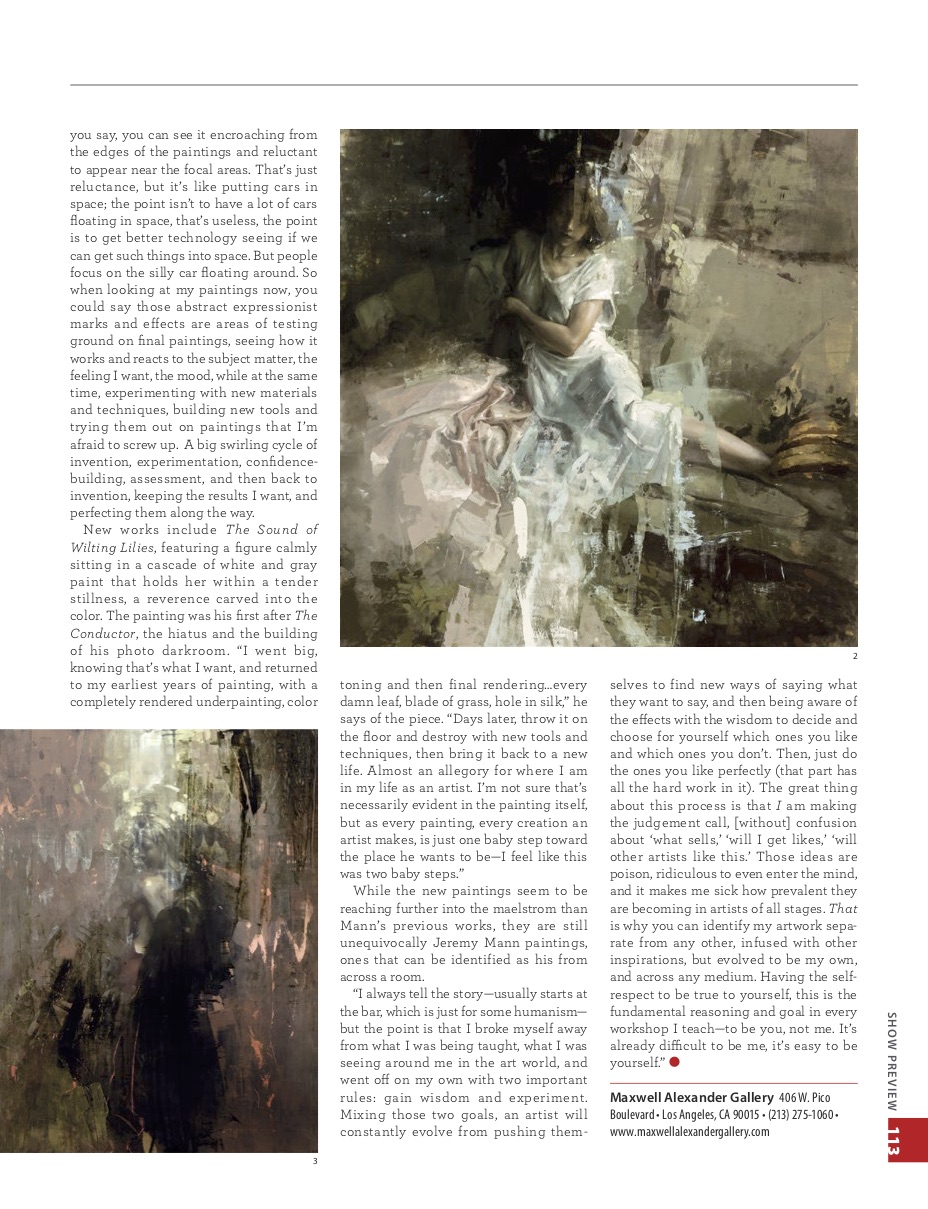
New works include The Sound of Wilting Lilies, featuring a figure calmly sitting in a cascade of white and gray paint that holds her within a tender stillness, a reverence carved into the color. The painting was his first after The Conductor, the hiatus and the building of his photo darkroom. “I went big, knowing that’s what I want, and returned to my earliest years of painting, with a completely rendered underpainting, color toning and then final rendering...every damn leaf, blade of grass, hole in silk,” he says of the piece. “Days later, throw it on the floor and destroy with new tools and techniques, then bring it back to a new life. Almost an allegory for where I am in my life as an artist. I’m not sure that’s necessarily evident in the painting itself, but as every painting, every creation an artist makes, is just one baby step toward the place he wants to be—I feel like this was two baby steps.”

While the new paintings seem to be reaching further into the maelstrom than Mann’s previous works, they are still unequivocally Jeremy Mann paintings, ones that can be identified as his from across a room. “I always tell the story—usually starts at the bar, which is just for some humanism— but the point is that I broke myself away from what I was being taught, what I was seeing around me in the art world, and went off on my own with two important rules: gain wisdom and experiment. Mixing those two goals, an artist will constantly evolve from pushing them-selves to find new ways of saying what they want to say, and then being aware of the effects with the wisdom to decide and choose for yourself which ones you like and which ones you don’t. Then, just do the ones you like perfectly (that part has all the hard work in it). The great thing about this process is that I am making the judgement call, [without] confusion about ‘what sells,’ ‘will I get likes,’ ‘will other artists like this.’ Those ideas are poison, ridiculous to even enter the mind, and it makes me sick how prevalent they are becoming in artists of all stages. That is why you can identify my artwork sepa- rate from any other, infused with other inspirations, but evolved to be my own, and across any medium. Having the self- respect to be true to yourself, this is the fundamental reasoning and goal in every workshop I teach—to be you, not me. It’s already difficult to be me, it’s easy to be yourself.

Tags American Art Collector Magazine, Jeremy Mann, California painter, Figurative Painting
PRE-Maxwell Alexander Gallery (dragged).jpg PRE-Maxwell Alexander Gallery (dragged) 2.jpg

American Art Collector Previews Painting Now

August 1, 2018

American Art Collector Editor Josh Rose Curates Exhibition

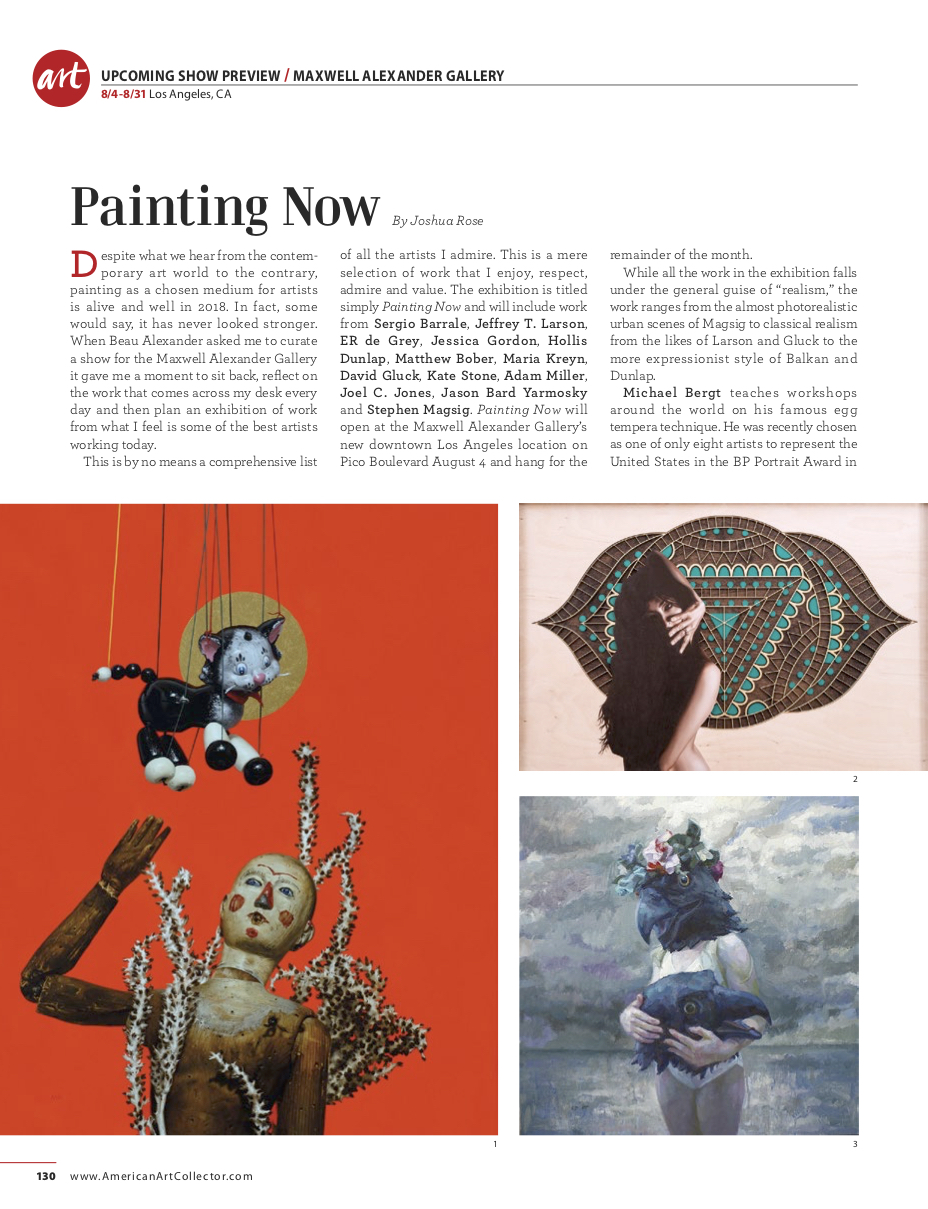
Despite what we hear from the contemporary art world to the contrary, painting as a chosen medium for artists is alive and well in 2018. In fact, some would say, it has never looked stronger. When Beau Alexander asked me to curate a show for the Maxwell Alexander Gallery it gave me a moment to sit back, reflect on the work that comes across my desk every day and then plan an exhibition of work from what I feel is some of the best artists working today. 

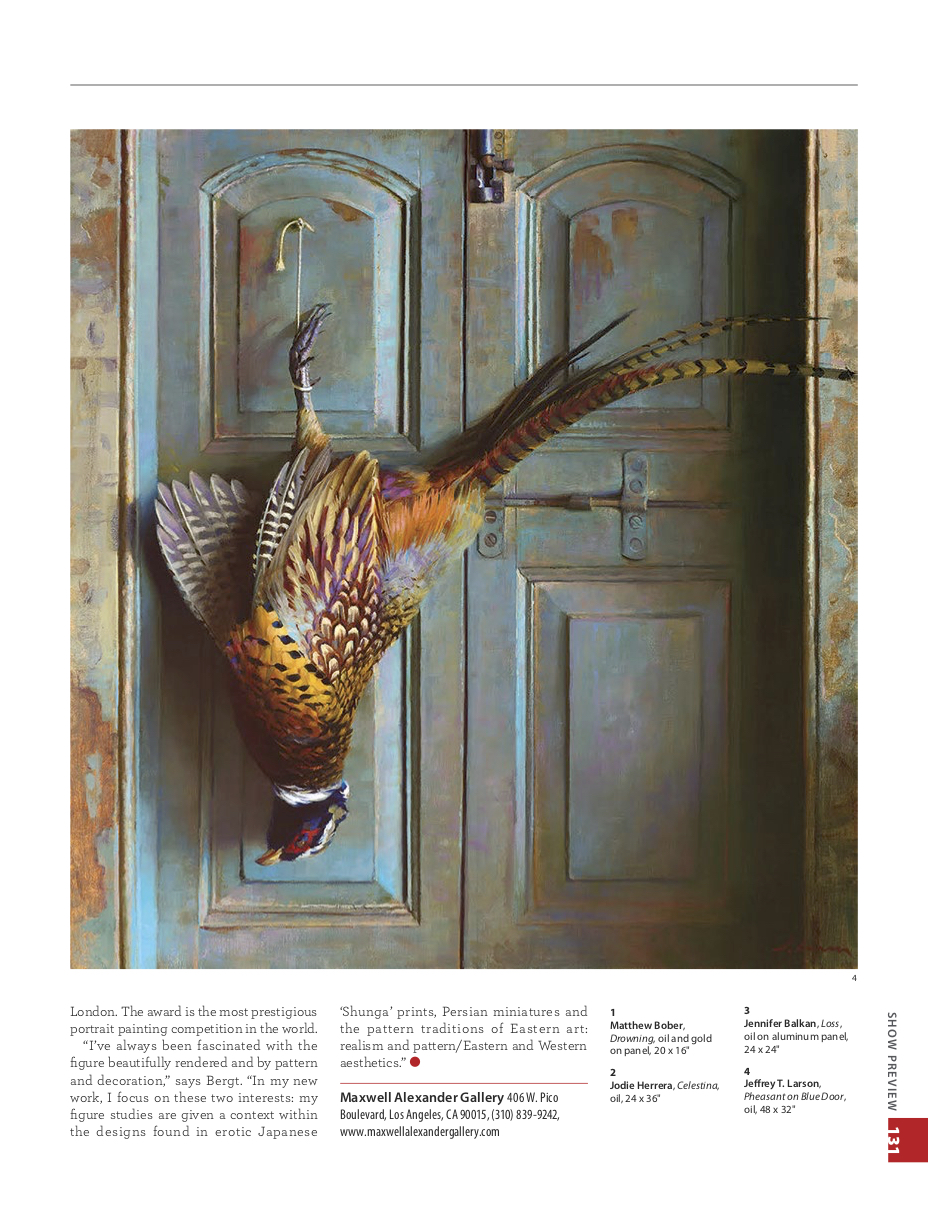
This is by no means a comprehensive list of all the artists I admire. This is a mere selection of work that I enjoy, respect, admire and value. The exhibition is titled simply Painting Now and will include work from Sergio Barrale,Jeffrey T. Larson, ER de Grey, Jessica Gordon, Hollis Dunlap, Matthew Bober, Maria Kreyn, David Gluck, Kate Stone, Adam Miller, Joel C. Jones, Jason Bard Yarmosky and Stephen Magsig. Painting Now will open at the Maxwell Alexander Gallery’s new downtown Los Angeles location on Pico Boulevard August 4 and hang for the remainder of the month.While all the work in the exhibition falls under the general guise of “realism,” the work ranges from the almost photorealistic urban scenes of Magsig to classical realism from the likes of Larson and Gluck to the more expressionist style of Balkan and Dunlap. 

Michael Bergt teaches workshops around the world on his famous egg tempera technique. He was recently chosen as one of only eight artists to represent the United States in the BP Portrait Award in London. The award is the most prestigious portrait painting competition in the world. “I’ve always been fascinated with the figure beautifully rendered and by pattern and decoration,” says Bergt. “In my new work, I focus on these two interests: my figure studies are given a context within the designs found in erotic Japanese ‘Shunga’ prints, Persian miniatures and the pattern traditions of Eastern art: realism and pattern/Eastern and Western aesthetics.” 

To view the full exhibition, click here.

Tags American Art Collector, Painting Now
IMG_3510.jpg
IMG_3511.jpg
IMG_3512.jpg

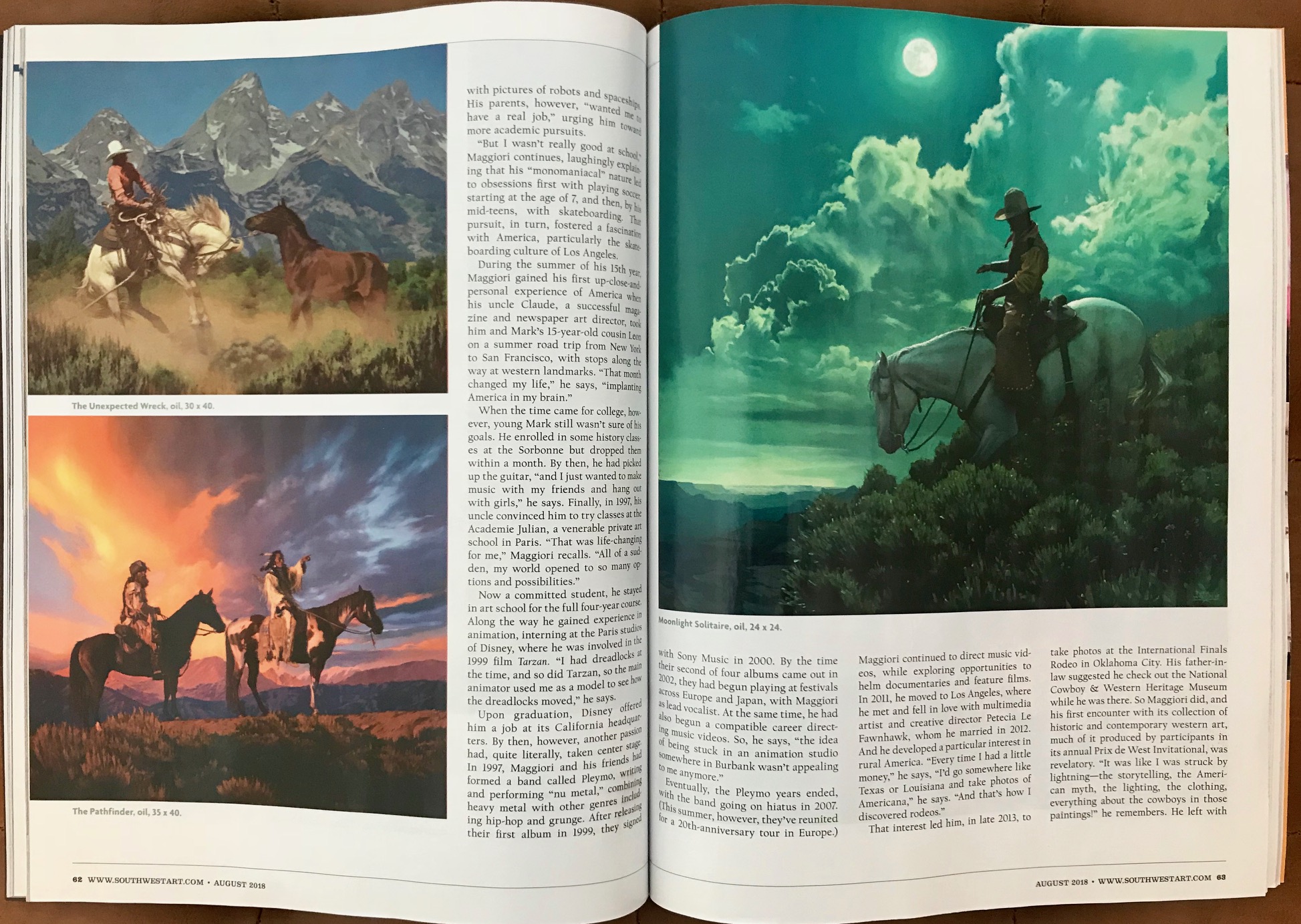
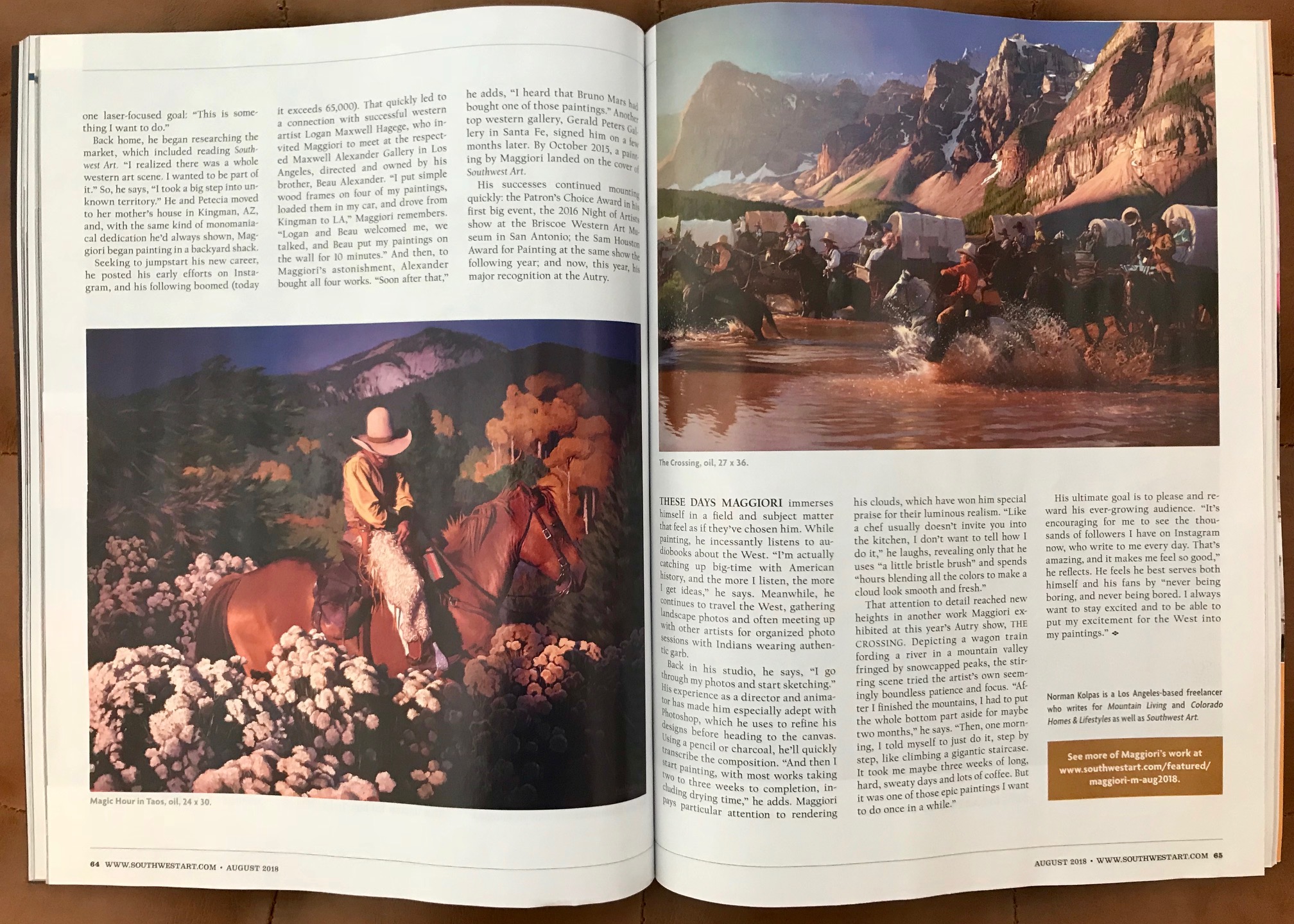
Southwest Art Interviews Mark Maggiori

July 16, 2018

Mark Maggiori: Lightning Strike

Courtesy of Southwest Art July 16, 2018

by Norman Klopas

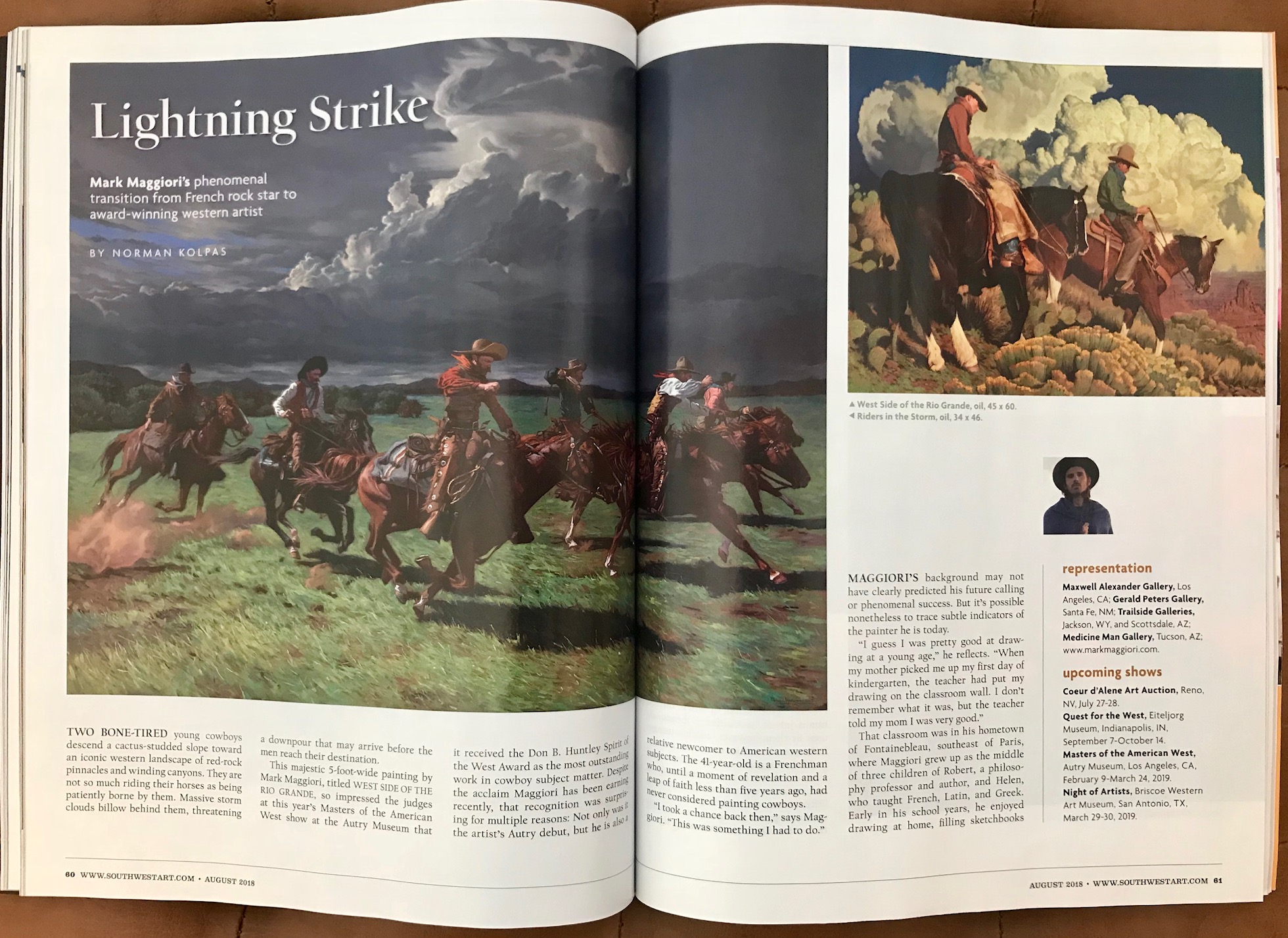
Two bone-tired young cowboys descend a cactus-studded slope toward an iconic western landscape of red-rock pinnacles and winding canyons. They are not so much riding their horses as being patiently borne by them. Massive storm clouds billow behind them, threatening a downpour that may arrive before the men reach their destination.

This majestic 5-foot-wide painting by Mark Maggiori, titled WEST SIDE OF THE RIO GRANDE, so impressed the judges at this year’s Masters of the American West show at the Autry Museum that it received the Don B. Huntley Spirit of the West Award as the most outstanding work in cowboy subject matter. Despite the acclaim Maggiori has been earning recently, that recognition was surprising for multiple reasons: Not only was it the artist’s Autry debut, but he is also a relative newcomer to American western subjects. The 41-year-old is a Frenchman who, until a moment of revelation and a leap of faith less than five years ago, had never considered painting cowboys.

“I took a chance back then,” says Maggiori. “This was something I had to do.”

Maggiori’s background may not have clearly predicted his future calling or phenomenal success. But it’s possible nonetheless to trace subtle indicators of the painter he is today.
“I guess I was pretty good at drawing at a young age,” he reflects. “When my mother picked me up my first day of kindergarten, the teacher had put my drawing on the classroom wall. I don’t remember what it was, but the teacher told my mom I was very good.” That classroom was in his hometown of Fontainebleau, southeast of Paris, where Maggiori grew up as the middle of three
children of Robert, a philosophy professor and author, and Helen, who taught French, Latin, and Greek. Early in his school years, he enjoyed drawing at home, filling sketchbooks with pictures of robots and spaceships. His parents, however, “wanted me to have a real job,” urging him toward more academic pursuits.

“But I wasn’t really good at school,” Maggiori continues, laughingly explaining that his “monomaniacal” nature led to obsessions first with playing soccer, starting at the age of 7, and then, by his mid-teens, with skateboarding. That pursuit, in turn, fostered a fascination with America, particularly the skateboarding culture of Los Angeles.

During the summer of his 15th year, Maggiori gained his first up-close-and-personal experience of America when his uncle Claude, a successful magazine and newspaper art director, took him and Mark’s 15-year-old cousin Leon on a summer road trip from New York to San Francisco, with stops along the way at western landmarks. “That month changed my life,” he says, “implanting America in my brain.”

When the time came for college, however, young Mark still wasn’t sure of his goals. He enrolled in some history classes at the Sorbonne but dropped them within a month. By then, he had picked up the guitar, “and I just wanted to make music with my friends and hang out with girls,” he says. Finally, in 1997, his uncle convinced him to try classes at the Academie Julian, a venerable private art school in Paris. “That was life-changing for me,” Maggiori recalls. “All of a sudden, my world opened to so many options and possibilities.”

Now a committed student, he stayed in art school for the full four-year course. Along the way he gained experience in animation, interning at the Paris studios of Disney, where he was involved in the 1999 film Tarzan. “I had dreadlocks at the time, and so did Tarzan, so the main animator used me as a model to see how the dreadlocks moved,” he says.

Upon graduation, Disney offered him a job at its California headquarters. By then, however, another passion had, quite literally, taken center stage. In 1997, Maggiori and his friends had formed a band called Pleymo, writing and performing “numetal,” combining heavy metal with other genres including hip-hop and grunge. After releasing their first album in 1999, they signed with Sony Music in 2000. By the time their second of four albums came out in 2002, they had begun playing at festivals across Europe and Japan, with Maggiori as lead vocalist. At the same time, he had also begun a compatible career directing music videos. So, he says, “the idea of being stuck in an animation studio somewhere in Burbank wasn’t appealing to me anymore.”

Eventually, the Pleymo years ended, with the band going on hiatus in 2007. (This summer, however, they’ve reunited for a 20th-anniversary tour in Europe.) Maggiori continued to direct music videos, while exploring opportunities to helm documentaries and feature films. In 2011, he moved to Los Angeles, where he met and fell in love with multimedia artist and creative director Petecia Le Fawnhawk, whom he married in 2012. And he developed a particular interest in rural America. “Every time I had a little money,” he says, “I’d go somewhere like Texas or Louisiana and take photos of Americana,” he says. “And that’s how I discovered rodeos.”

That interest led him, in late 2013, to take photos at the International Finals Rodeo in Oklahoma City. His father-in-law suggested he check out the National Cowboy & Western Heritage Museum while he was there. So Maggiori did, and his first encounter with its collection of historic and contemporary western art, much of it produced by participants in its annual Prix de West Invitational, was revelatory. “It was like I was struck by lightning—the storytelling, the American myth, the lighting, the clothing, everything about the cowboys in those paintings!” he remembers. He left with one laser-focused goal: “This is something I want to do.”

Back home, he began researching the market, which included reading Southwest Art. “I realized there was a whole western art scene. I wanted to be part of it.” So, he says, “I took a big step into unknown territory.” He and Petecia moved to her mother’s house in Kingman, AZ, and, with the same kind of monomaniacal dedication he’d always shown, Maggiori began painting in a backyard shack.

Seeking to jumpstart his new career, he posted his early efforts on Instagram, and his following boomed (today it exceeds 65,000). That quickly led to a connection with successful western artist Logan Maxwell Hagege, who invited Maggiori to meet at the respected Maxwell Alexander Gallery in Los Angeles, directed and owned by his brother, Beau Alexander. “I put simple wood frames on four of my paintings, loaded them in my car, and drove from Kingman to LA,” Maggiori remembers.


“Logan and Beau welcomed me, we talked, and Beau put my paintings on the wall for 10 minutes.” And then, to Maggiori’s astonishment, Alexander bought all four works. “Soon after that,” he adds, “I heard that Bruno Mars had bought one of those paintings.” Another top western gallery, Gerald Peters Gallery in Santa Fe, signed him on a few months later. By October 2015, a painting by Maggiori landed on the cover of Southwest Art.

His successes continued mounting quickly: the Patron’s Choice Award in his first big event, the 2016 Night of Artists show at the Briscoe Western Art Museum in San Antonio; the Sam Houston Award for Painting at the same show the following year; and now, this year, his major recognition at the Autry.

These days Maggiori immerses himself in a field and subject matter that feel as if they’ve chosen him. While painting, he incessantly listens to audiobooks about the West. “I’m actually catching up big-time with American history, and the more I listen, the more I get ideas,” he says. Meanwhile, he continues to travel the West, gathering landscape photos and often meeting up with other artists for organized photo sessions with Indians wearing authentic garb.

Back in his studio, he says, “I go through my photos and start sketching.” His experience as a director and animator has made him especially adept with Photoshop, which he uses to refine his designs before heading to the canvas. Using a pencil or charcoal, he’ll quickly transcribe the composition. “And then I start painting, with most works taking two to three weeks to completion, including drying time,” he adds. Maggiori pays particular attention to rendering his clouds, which have won him special praise for their luminous realism. “Like a chef usually doesn’t invite you into the kitchen, I don’t want to tell how I do it,” he laughs, revealing only that he uses “a little bristle brush” and spends “hours blending all the colors to make a cloud look smooth and fresh.”

That attention to detail reached new heights in another work Maggiori exhibited at this year’s Autry show, THE CROSSING. Depicting a wagon train fording a river in a mountain valley fringed by snowcapped peaks, the stirring scene tried the artist’s own seemingly boundless patience and focus. “After I finished the mountains, I had to put the whole bottom part aside for maybe two months,” he says. “Then, one morning, I told myself to just do it, step by step, like climbing a gigantic staircase. It took me maybe three weeks of long, hard, sweaty days and lots of coffee. But it was one of those epic paintings I want to do once in a while.”

His ultimate goal is to please and reward his ever-growing audience. “It’s encouraging for me to see the thousands of followers I have on Instagram now, who write to me every day. That’s amazing, and it makes me feel so good,” he reflects. He feels he best serves both himself and his fans by “never being boring, and never being bored. I always want to stay excited and to be able to put my excitement for the West into my paintings.”

For more work by Mark Maggiori, click here.
In Press Coverage Tags Mark Maggiori, Western Art, Southwest Art Magazine
← Newer Posts Older Posts →

All Content © Maxwell Alexander Gallery 2023